
U.S. increases pressure on Maduro with Venezuela strike
Clip: 12/30/2025 | 5m 1sVideo has Closed Captions
With strike inside Venezuela, U.S. increases pressure on Maduro regime
It is rare that a U.S. president would announce covert action publicly. But that is what President Trump did Monday when he acknowledged a strike on a port facility in Venezuela. Media outlets reported it was the CIA that launched the drone strike. It comes as the administration is targeting not only drug smugglers, but Venezuelan President Nicolas Maduro himself. Nick Schifrin reports.
Problems playing video? | Closed Captioning Feedback
Problems playing video? | Closed Captioning Feedback
Major corporate funding for the PBS News Hour is provided by BDO, BNSF, Consumer Cellular, American Cruise Lines, and Raymond James. Funding for the PBS NewsHour Weekend is provided by...
U.S. increases pressure on Maduro with Venezuela strike
Clip: 12/30/2025 | 5m 1sVideo has Closed Captions
It is rare that a U.S. president would announce covert action publicly. But that is what President Trump did Monday when he acknowledged a strike on a port facility in Venezuela. Media outlets reported it was the CIA that launched the drone strike. It comes as the administration is targeting not only drug smugglers, but Venezuelan President Nicolas Maduro himself. Nick Schifrin reports.
Problems playing video? | Closed Captioning Feedback
How to Watch PBS News Hour
PBS News Hour is available to stream on pbs.org and the free PBS App, available on iPhone, Apple TV, Android TV, Android smartphones, Amazon Fire TV, Amazon Fire Tablet, Roku, Samsung Smart TV, and Vizio.
Providing Support for PBS.org
Learn Moreabout PBS online sponsorshipNICK SCHIFRIN: Welcome to the "News Hour."
It is exceedingly rare that a U.S.
president would announce covert action publicly, but that is what President Trump did yesterday when he acknowledged a strike on a port facility in Venezuela.
And, today, media outlets reported it was the CIA that launched the drone strike on an alleged drug facility.
It comes as the Trump administration is targeting not only drug smugglers across the region, but also Venezuelan President Nicolas Maduro himself.
For months, the U.S.
has built up the Caribbean's largest armada in half-a-century, 30 strikes on what the U.S.
calls narco-terrorist drug boats, the latest in the Eastern Pacific just last night, the capture of two sanctioned Venezuelan oil tankers and the chasing of a third tanker that today reportedly requested Russian protection.
And, today, news the CIA reportedly launched a drone strike along the Venezuelan coast, the reported target, a storage facility operated by the transnational gang Tren de Aragua, which the Trump administration connects, without public evidence, to Venezuelan President Nicolas Maduro.
DONALD TRUMP, President of the United States: There was a major explosion in the dock area where they load the boats up with drugs.
They load the boats up with drugs.
So we hit all the boats.
And now we hit the area.
It's the implementation area.
That's where they implement.
And that is no longer around.
ELLIOTT ABRAMS, Council on Foreign Relations: If the amount of drug trafficking comes down significantly in the Caribbean, and I think it must, the regime is going to have a lot less money to throw around.
NICK SCHIFRIN: Elliott Abrams was the first Trump administration's special envoy for Venezuela and is today a senior fellow for the Council on Foreign Relations.
He supports the pressure campaign that is targeting Venezuela's chief source of revenue as a way to weaken Maduro's grip on power and force him to step down.
ELLIOTT ABRAMS: The economy of Venezuela will get worse and the finances of the Maduro regime will get worse and that will increase public pressure and internal pressure in the regime, that at some point there are either mass demonstrations or somebody in the military acts or the regime basically decides, we don't know how far Trump is willing to go with this.
Let's make a deal now.
NICK SCHIFRIN: But the administration's critics argue the pressure campaign's tactics are illegal and its goals are imperialist.
DANIEL HELLINGER, Professor Emeritus of International Relations Webster University: It's straightforward territorial intervention.
It's the kind of thing that was characteristic of the United States in the Caribbean region back in the beginnings of the 20th century.
NICK SCHIFRIN: Daniel Hellinger is a Webster University professor emeritus who says Maduro is not the threat that the U.S.
alleges.
DANIEL HELLINGER: I don't think he's sort of the kingpin that they're trying to portray him to be.
Venezuela does not traffic in fentanyl to any significant degree and that most of what comes out of Venezuela is more likely to be marijuana or cocaine, and even that doesn't even come towards the United States.
NICK SCHIFRIN: Maduro himself this week has been trying to laugh or sing past the pressure in between boasts and bravado.
NICOLAS MADURO, Venezuelan President (through translator): Our military have a glorious history as emancipating humanist invincible warriors.
Today, our armed forces are more prepared than ever to continue winning peace, sovereignty and territorial integrity for our people.
NICK SCHIFRIN: And opponents of the Trump administration's policy predict that, if Maduro is ousted, there will be chaos.
DANIEL HELLINGER: Venezuela is a heavily armed society in the civilian sector.
There are going to be parts of the Venezuelan military that will retreat into guerrilla warfare.
And there's just a very dense population in Caracas, where crime is a serious problem, and there's lots of lots of firearms around.
So it'll get messy.
ELLIOTT ABRAMS: The warnings that there will be civil war in Venezuela and massive amounts of violence I think are wrong, that, if Maduro falls, Edmundo Gonzalez, who was elected last year, will become president.
And the opposition is planning for that right now and planning for what a democratic transition will look like.
As long as the Maduro regime is there, we are not going to get its cooperation in reducing drug trafficking.
You're going to see the continuing flow of migrants, eight million down, and there's no reason that it can't go to nine or 10 or 12 million over the coming years.
And you're going to see continuing cooperation between the regime and Cuba, Iran, Russia, China.
NICK SCHIFRIN: Maduro has not acknowledged the alleged CIA strike, perhaps to avoid further escalation, but more confrontation is coming, as the U.S.
is promising more pressure.
Artists hope to preserve, rebuild Gaza’s cultural heritage
Video has Closed Captions
Clip: 12/30/2025 | 9m 40s | Artists hope to preserve and rebuild Gaza’s cultural heritage (9m 40s)
Federal agents probe Minnesota child care fund allegations
Video has Closed Captions
Clip: 12/30/2025 | 6m 46s | Federal agents probe fraud allegations targeting Somali child care providers in Minnesota (6m 46s)
How Kharkiv preserves faith and culture under Russia's siege
Video has Closed Captions
Clip: 12/30/2025 | 4m 49s | How Kharkiv keeps faith and culture alive as Russia's siege continues (4m 49s)
How retirements and redistricting could impact the midterms
Video has Closed Captions
Clip: 12/30/2025 | 5m 5s | How retirements and redistricting could impact the 2026 midterms (5m 5s)
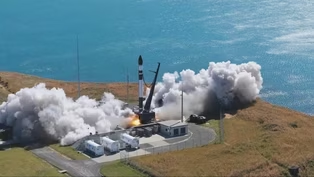
Inside Rocket Lab's effort to outpace larger space rivals
Video has Closed Captions
Clip: 12/30/2025 | 8m 39s | Inside Rocket Lab's effort to outpace larger space rivals (8m 39s)
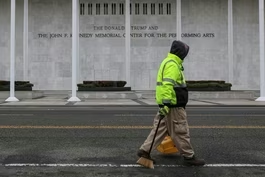
News Wrap: More artists cancel Kennedy Center shows
Video has Closed Captions
Clip: 12/30/2025 | 5m 39s | News Wrap: More artists cancel Kennedy Center shows after Trump's name added to building (5m 39s)
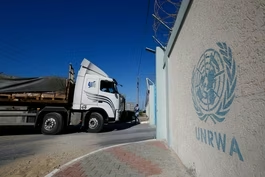
U.S. unveils new plan for delivering humanitarian aid
Video has Closed Captions
Clip: 12/30/2025 | 7m 1s | U.S. unveils new plan for humanitarian aid after pausing contributions earlier this year (7m 1s)
Providing Support for PBS.org
Learn Moreabout PBS online sponsorship
- News and Public Affairs

FRONTLINE is investigative journalism that questions, explains and changes our world.

- News and Public Affairs

Today's top journalists discuss Washington's current political events and public affairs.









Support for PBS provided by:
Major corporate funding for the PBS News Hour is provided by BDO, BNSF, Consumer Cellular, American Cruise Lines, and Raymond James. Funding for the PBS NewsHour Weekend is provided by...