
Culinary Roots
Season 2 Episode 2 | 23m 20sVideo has Closed Captions
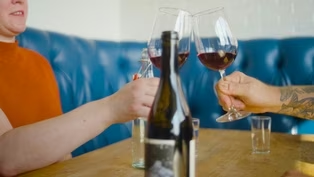
Yaupon tea and drinking chocolates are steeped in history. Texas wine seeks vindication.
Yaupon tea and Mexican drinking chocolates are steeped in tradition. Meanwhile, the Texas wine industry fights for vindication.
Problems playing video? | Closed Captioning Feedback
Problems playing video? | Closed Captioning Feedback
Production Support Provided By: H-E-B and Texas Parks & Wildlife Foundation
Culinary Roots
Season 2 Episode 2 | 23m 20sVideo has Closed Captions
Yaupon tea and Mexican drinking chocolates are steeped in tradition. Meanwhile, the Texas wine industry fights for vindication.
Problems playing video? | Closed Captioning Feedback
Where to Watch Texas Monthly Presents: The Story
Texas Monthly Presents: The Story is available to stream on pbs.org and the PBS app.
Providing Support for PBS.org
Learn Moreabout PBS online sponsorship- Texas is amazing as far as what's here.
(dramatic music) - The first word that comes to mind is just pure.
- It's so magical.
- There's the old rumor that won't die.
Texas wine is bad.
- [Speaker] Yaupon is a very sacred plant.
- I was shocked by the wines I tried.
Really elegant.
- You have this culture that you come from.
- [Speaker] They become like family.
- We need to share with the world what these areas of Texas taste like.
(dramatic music) (upbeat music) - The first word that comes to mind over and over is just pure.
It tastes pure.
What you would imagine cacao would taste like if you were to know someone that had the skills to take out the beans and to create this.
There's like a whole person and a whole like history of a country here, you know, a whole history of a family.
It's a much broader story to be told.
My name is Amanda Albee and I wrote "Tastes Like Home" for Texas Monthly.
(upbeat dramatic music) I found out about Hijita because I was looking for Texas makers.
She is the only chocolate maker in Texas that I know of that gets her cacao from various farms in Mexico, and not just the cacao, the piloncillo, the ceylon cinnamon, the vanilla.
Ashley is not only making single origin chocolates, she's also using it as a way to reclaim her heritage and to tell the story of Mexican chocolate.
- I feel like so many of my core memories from my childhood were around food.
And I realized I love to cook because I love to eat.
So it kind of started from very young.
As soon as I could reach the stove, I wanted to cook.
- [Amanda] Ashley grew up in Laredo and whenever she would visit her grandmother across the border in Nuevo Laredo, it was always tradition, especially around the holidays, to drink Abuelita hot chocolate.
So her connection to chocolate goes way back.
(soft music) - I always wanted my parents to be proud of me.
And my mom is an immigrant from Mexico, so she's always been like academics, like super that immigrant like mom mentality of like go be an engineer or a doctor, and you know, become wealthy.
- She was a straight A student in school.
Her parents had high expectations and she also was just very ambitious and she had planned to become a doctor, you know?
She was good at school and that was the plan.
- I was actually, I was pre-med in college, which is nothing related to this at all.
Yeah, I went to Rice University in Houston and really thought I was going to, I mean, I though I was going to be a doctor since I was little and I was definitely on that path.
And then I went on a trip to Ecuador that totally changed my life.
- [Amanda] It was from that trip where she worked on that farm in Esmeraldas that she, I think that was maybe her first relationship with a farmer.
And she had always loved food and she wanted to continue to explore that relationship with farmers.
That's why she decided to move to the Bay Area.
While she was in San Francisco, she wound up working at Dandelion Chocolate, which is one of America's leading bean-to-bar chocolate makers.
- [Ashley] At Dandelion, I learned so much, obviously, so much about chocolate, so much about integrity and ethics and something inside of me all of a sudden had this inspiration and this question of what story can you tell with chocolate?
You have this culture that you come from that is deeply, deeply rooted in cacao culture from Mesoamerican times.
And I thought, how can you tell that story through your lens?
- [Amanda] I don't know if it was the first time she went into Dandelion chocolate, but there was a day she went in there and she picked up a bar and it came from that same farm that she volunteered with in Esmeraldas.
And that's when she like realized like, "Okay, it all makes sense now."
Like this is what I'm going to do.
- And so I remember I was like, I went home, back home to Laredo, back home to Nuevo Laredo to see my grandma like one last time before this whole like change happened.
And I told my mom, I said, "Mom, I'm not going to be a doctor.
I'm going to be a chef."
And you should see the like, the life that left her eyes of sadness and disappointment.
But I said, "Mom, don't worry.
I'm gonna to do something amazing.
- [Amanda] Ashley worked at Dandelion from 2018 to 2022 and that's when she returned to Austin and that was when she started Hijita.
- [Speaker] Nice.
(upbeat playful music) - [Amanda] I think once people tried her chocolates, they wanted more of it.
She makes bars, chocolate bars, crunch bars.
She also makes truffles and she makes drinking chocolates, both the kind that's shaped like the Abuelita tablets.
And then she also sells at the farmer's market her iced chocolates.
The name is really interesting because, you know, Abuelita means grandma and to call her business Hijita, you know, daughters, as she says, have just as much role in passing on traditions.
(soft music) - I would say what differentiates Hijita from kind of like mainstream manufactured Mexican chocolate is more of a focus on Mexico and specifically using Mexican cacao.
Mexican cacao is very rare.
It's very, you know, it's not exported a lot.
And we have very unique and beautiful techniques around cacao that I think haven't really been highlighted as much.
Going to the farms is my favorite part of the whole thing.
It is beautiful and you feel very connected with like the process of making chocolate because without the farm, without the farmer, there is no chocolate farm.
There's no chocolate.
So this is our collaboration with Dandelion and we have our two bars in here.
So we have the pink masapan and the marranito pan dulce bar.
And this collection is very full circle and special to me because I'm getting to use Dandelion's first batch of chocolate made with Mexican beans.
And we both work with this same farmer.
So it's like, I don't know.
It's so magical.
It's really exciting.
(soft piano music) - [Amanda] She's honoring, you know, kind of all the generations, from her grandmother to her mother to her role now as, you know, a Mexican American that's trying to bring this recognition to Mexican chocolate because it, you know, it really does represent Mexico and its history in a really interesting way that's not always told.
(soft inspirational music) - I think so much of what I do is because I was almost given this opportunity by my mom because she came here hoping for like a better life for me and my sister.
And so like when I get to see her go around the farmer's market and she is like best friends with everybody at the market now, like everybody knows my mom.
And she goes, "My daughter is Hijita."
And she's so proud and I'm like, at the end of the day, that's all I ever wanted.
To be proud and to show like how proud I am of like my mom's country.
And to go back to that time when I said, "Mom, trust me.
I promise, you're going to see what I can do."
(soft inspirational music) (soft music) - [Jason] Texas is amazing as far as like what's here.
And people don't really understand.
There's still a lot to learn.
There's something really fulfilling about just going out into the woods and foraging.
I mean, it's what we were made to do as humans, you know, like our ancestors foraged.
It fulfills something, I think, in us to do that, like being connected to the natural world.
Yaupon really helps me connect with that.
Once you recognize what Yaupon is, it is absolutely everywhere.
If you're in Bastrop, it's the understory to the pine forest out here.
I think we're going to harvest over here, but I'll just take y'all around here real quick.
I'm going to take a look at all these Yaupons, see if this is what I want.
This will do, yep.
(soft piano music) I was looking through a Native American ethnobotany book and found out that people around here were using yaupon for caffeine.
I went out and started, you know, playing around with just roasting Yaupon and found out it was great.
Yaupon is a native Texas plant.
It's a Holly.
It's the only caffeinated plant native to North America.
It's a relative of the South American yerba mate.
Grows wild in central Texas all along the Gulf Coast, pretty much from where we are here in central Texas, east all the way to Georgia.
It's absolutely everywhere.
Yaupon has theobromine.
Theobromine is the mood elevator in cacao.
It's a feel good thing in chocolate.
We call it the pleasure molecule.
It also has theacrine, and theophylline.
It's high in antioxidants up there with green tea.
We do a light roast and a dark roast.
The light roast tastes similar to green tea.
And we do a dark roast that is very blackteaish, kind of whiskey barrel, smoky, roasty, oaki.
Yaupon is new to us nowadays, but it's been around for thousands of years.
(William singing in indigenous language) - Yaupon is something that's part of us and we're part of it.
(soft piano music) Yaupon to us is a very sacred plant.
In our language it's called Gvnega Advdatsi, which means the black drink.
The first thing that we do when we're establishing a relationship with the stand of yaupon is we find the grandmother, the plant that looks over all the other stand of the yaupon.
We ask them to supply us with the medicine and the healing that we need and you honor that year after year.
They become like family.
Before our people went to war, before we had council meetings, before we had any major event, you would do a black drink ceremony.
We use it as a reminder of our ancestors.
(dramatic music) When we came into what is now Texas, it was Spain.
And when our people crossed over the border, one of the things that they saw was the yaupon or the Gvnega Advdatsi that grows here everywhere.
Our people said we're in a good place.
We can settle here because we have one of our sacred plants here.
And I feel the same way.
When I come home, the first thing I do is walk out into the woods and see my plants.
When I see it, it makes me feel like I'm home.
- You know, it doesn't have a bunch of junk in it.
Nice green leaves, really fresh.
And then chop them to about this size so they're manageable.
Yaupon is wildfire fuel and if it gets too tall, they call it ladder fuel because it will take a forest fire that, you know, is burning on the forest floor and bring that up into the tree canopy, which is what happened here in 2011.
(dramatic music) Cutting the yaupon down over and over kind of like mimics those natural fire cycles.
It keeps the yaupon from getting too tall.
- So what we've been trying to do is help the property recover.
We're in the process of trying to make sure that yaupon doesn't take over our property and basically let the loblolly pines come back in as they were before the fire.
- You know, sometimes you'll cut down a big old thing of yaupon.
There's a little baby pine tree underneath there.
And then right after that you come back like a year later and the pine tree's like really big.
It's cool.
First, let's get all of these big sticks out.
Just personally, it, it feels nice, it's fun.
I like being in the forest.
You know we're doing a good thing.
(inspirational music) When we first started, we would go out to markets.
"Have you ever had Yaupon before?
Nope, nope, nope, nope."
People love it.
They really like it.
They taste it and they're like, "Oh my God, this is so good."
I hope that yaupon keeps growing, obviously.
I see a lot of little yaupon companies pop up all the time, which I think is great.
The more people are doing it, the better, the more awareness.
- [William] It's a plant that was put here by the creator for us to use.
And so inadvertently, these people that are using it recreationally are getting medicinal benefits from a plant that we've used ceremonially and medicinally for generations.
My hope is that people start to recognize yaupon.
Once you recognize it, you can't miss it.
(inspirational music) (gusts of wind) (soft music) - Here in Texas, there's the old rumor that won't die.
Texas wine is bad.
(upbeat festive music) I think that that is very misinformed.
It's a very dated reputation for Texas wine to have.
I could tell something was different.
I could tell something was changing and I wanted to know what.
My name is Paula Forbes.
I'm a senior food and drinks writer at Texas Monthly and I wrote "Texas Wine Grows Up."
- We're going to do a couple wine tastings tonight.
We've got a new wine coming to the menu.
So we're going to start with Jaclynn Renée, a female winemaker, obviously, born and raised in Texas.
(upbeat playful music) - As a food writer, I've always been curious about learning about wine.
It always seemed like this sort of sophisticated black box, you know, the final frontier of food writing.
Specifically, I wanted to write about Texas wine because I had gone to Fredericksburg for a few different stories that had nothing to do with wine.
Driving down 290 and seeing rows of vineyards and the new buildings being put up, I could tell something was different.
And I just wanted to know what was going on, what was fueling all of this.
I was really curious to see how Texas wine had changed.
I went to more than a dozen wineries over five days and really tried to taste the most exciting, best, surprising, innovative wines that are being made in Texas today.
(soft music) I went to Ab Astris drawn in large part because I just though it was very, very beautiful.
- Texas is an awesome place because we have beaches, we have mountains, we have plains, we have farmland.
You know, Texas beef is amazing.
The cuisine is amazing.
People are proud of Texas and they should be.
And I think that adding Texas wine to that mix of Texas products is something that we should all be proud and excited about.
(upbeat music) - [Paula] Ab Astris is doing interesting things that kind of surprised me and I think speak to the ways Texas wines have grown varied and really improved the different types of wines you can get in the state.
- We made a big leap up trying to figure out what varietals grow well here as opposed to, you know, what varietals people just know off the top of their head.
And that's when you start to see these just world-class wines coming out of Texas.
It's a very exciting time for the industry, I think.
- Nationally, Texas' reputation has grown, so that's been great.
We'll get consumers in from California, or Louisiana.
or Oklahoma and they are so blown away and excited about the wine.
The challenges exist with Texans themselves.
There's still a stigma.
I think Texans tasted some not great Texas wine, you know, 20, 25 years ago and haven't really had an interest in coming back and seeing that things have changed.
(soft music) - [Paula] You would never know today that William Chris started out as a small winery, much like the other ones I visited for this story.
They have grown in ways you would not believe.
Their wines are very popular.
- We started with very little.
I came home and told my wife that I had quit my job and that we were starting our own brand and we weren't buying a house anymore and away we went, yeah.
It's pretty challenging to keep all the plates spinning in all the areas.
I mean, we're a farming company.
We're a wine production company.
You know, operate several tasting rooms.
It's a lot, but we love it.
- Before I reported this story, I didn't realize Texas wineries really have to hustle to get their wines into stores and restaurants.
- Let me go grab a glass and we'll find a good money shot over here.
- [Paula] Chris Brundrett told me he used to go hat in hand, almost apologetic about his wines.
And no more.
- I've really done so much great work, but who cares if you've got the best wine in the world and you got a great team, but you're not making any money, you're not going to be around for very long.
(inspirational music) You know, the margins are tough and you're competing against everybody in the whole entire world and so, you better bring it.
- Distribution is hard, especially there's a good amount of us out here that are pretty boutique.
And so a lot of us do self-distribution, which is a challenge because you need to be out here in your tasting room, taking care of your wine club and doing your events.
So the thought of running to cities around Texas once a week is kind of difficult.
We're small, so it's a whole different ballgame.
(soft music) - As hard as it is for Texas winemakers, especially the smaller ones to get into restaurants, there are several restaurants across the state that are making the effort to get those bottles in their restaurants.
Dai Due in Austin, Texas is one of them.
They've had an almost all Texas wine lists since 2014.
- Everybody go ahead and take a taste of the La Valentia.
I've built wine lists for other restaurants.
Usually the distributors are coming to you.
It's not exactly how it works here.
Sometimes it requires myself or someone else to go to the winery and pick up or make a drop off.
It is a different way of running a restaurant, but I think it's worth it.
We want to support who we can and we're going to do what we can to make sure that these wines are out there for the public to taste.
- You are one of the first and still one of the only as far as I know restaurants to have a full Texas wine list.
Why is that important to you?
- The Texas wine industry, it's kind of like, like a child in a way that like if you ignore the industry and mistreat it and tell it's never going to amount to anything, it's not going to.
But if you support it throughout and believe in it, it's like one day it's going to be where it is now.
(soft music) And I feel like we just stuck with it.
And to say that in 2014 when we opened with a full Texas wine list, were all the wines great?
No, they weren't.
But the industry has grown exponentially with us in that time.
And so our wine list is amazing.
Now, I like to say we have the best Texas wine list in the world.
(soft piano music) - I'm proud to live in a place that makes wine.
I think that that is a unique quality of this place.
It's part of our food story.
We have all of these different foods that you could spend a lifetime writing about and not get to all of them.
- There's so many different regions and so many different kinds of food, so much untapped potential as far as possible ingredients.
- [Amanda] And to see people kind of tapping into its history is really interesting.
- [Paula] I think Texans really want to eat local foods because they're proud of where they're from and it's an honor to write about all of these topics.
(inspirational music)
Video has Closed Captions
Preview: S2 Ep2 | 30s | Yaupon tea and drinking chocolates are steeped in history. Texas wine seeks vindication. (30s)
Providing Support for PBS.org
Learn Moreabout PBS online sponsorship












Support for PBS provided by:
Production Support Provided By: H-E-B and Texas Parks & Wildlife Foundation