Here and Now
Here & Now for April 3, 2026
Season 2400 Episode 2438 | 26m 48sVideo has Closed Captions
Watch the entire episode of Here & Now for April 3.
Watch the entire episode of Here & Now for April 3.
Problems playing video? | Closed Captioning Feedback
Problems playing video? | Closed Captioning Feedback
Here and Now is a local public television program presented by PBS Wisconsin
Here and Now
Here & Now for April 3, 2026
Season 2400 Episode 2438 | 26m 48sVideo has Closed Captions
Watch the entire episode of Here & Now for April 3.
Problems playing video? | Closed Captioning Feedback
How to Watch Here and Now
Here and Now is available to stream on pbs.org and the free PBS App, available on iPhone, Apple TV, Android TV, Android smartphones, Amazon Fire TV, Amazon Fire Tablet, Roku, Samsung Smart TV, and Vizio.
Providing Support for PBS.org
Learn Moreabout PBS online sponsorshipPBS Wisconsin Original production.
>> Candidates to be the next Supreme Court Justice make their final case to the voters.
And with an election just days away.
>> That's a big deal.
>> An executive order raises questions and lawsuits.
I'm Frederica Freyberg.
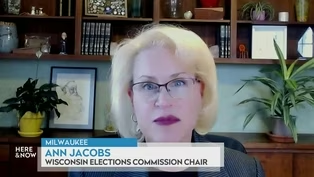
Tonight on "Here& Now", the chair of the Wisconsin Elections Commission answers questions about the executive order from President Trump.
We break down highlights from the debate between the Supreme Court candidates.
Plus how they're convincing voters to turn out on Tuesday.
And with a crisis of care for children and seniors, one model is bringing them all together.
It's "Here& Now" for April 3rd.
>> Funding for "Here& Now" is provided by the fund for Journalism and Friends of PBS Wisconsin.
>> Just as Wisconsin is heading to the polls next Tuesday, calls from Washington to nationalize elections.
The executive order President Trump signed this week would create a national list of U.S.
citizens eligible to vote and restrict mail in ballots.
This order is not in effect for our April 7th election, and Democrats have filed a lawsuit over it.
But does it perpetuate mistrust in the voting process?
We turn to the chair of the Wisconsin Elections Commission.
And Jacobs, thanks very much for being here.
>> Happy to be here.
>> So what is your reaction to President Trump's executive order?
>> I think it was at best unfortunate and at worst unconstitutional.
The administration of elections is delegated by the U.S.
Constitution to the states, and Congress can make laws regulating elections.
And an executive order is neither of those things.
>> And so it's your belief that this would not be in effect for the November elections or, in effect, ever.
>> My suspicion is never in effect, ever.
It's sort of a back door way to create time limits and new administrative hurdles for voters to go through.
Under the auspices of addressing essentially what our conspiracy theories about absentee balloting.
>> So if it were to go into effect, what would the ramifications be?
In Wisconsin?
>> So in Wisconsin, by way of example, you can request an absentee ballot five days before an election and you are eligible to vote.
If you've been a resident of Wisconsin for 28 days.
So a new resident of Wisconsin could come and ask for a ballot and have the right to vote under the executive order.
However, that name and that address had to have been submitted to the US government prior to 60 days before the election.
So you create conflicts between the statutory rights under state law with this mailing deadline, and now the government's going to control whether they will even mail your ballot.
And how do you undo that?
What is the remedy if the government says, oh, you weren't on the list, so I'm not going to mail your ballot?
Ha ha.
And the reason they're not mailing it is maybe because there's a typo in a list somewhere, or you moved or what have you.
So it's really just sort of creating an unnecessary and unworkable mess.
>> In, in your mind.
Is it more possible with mail in ballots to experience voter fraud?
>> No, the short answer is no.
There's a number of checks and balances involved in addressing mail in ballots.
First of all, you got to be registered.
Being registered in Wisconsin requires a driver's license or the last four digits of your Social Security number.
If you don't have a license or ID, it has to go to your registered voter address.
If you're sending it somewhere else, we send a postcard to your registered voter address saying, hey, did you order this ballot to go somewhere else?
It requires a witness with an address to sign your absentee ballot envelope that affirms that they know you and they saw you complete this ballot.
And then when it comes in to the elections, municipal clerks across the state, they check it off, check it in, and that ballot then is tallied.
There's just a lot of checks and balances along the way.
>> This executive order also seems to be trying to get at the issue of only U.S.
citizens voting, because that is considered in in some corners, you know, rampant with with fraud.
What is your knowledge of whether that is happening here in Wisconsin?
Non-Citizens voting?
>> We actually have some numbers on that.
There are four documented cases of non-citizen voting since 2016.
During that time, 25 million ballots have been issued in the state of Wisconsin.
And if you want to do the math, it's like 0.000000 something something.
Of all ballots cast, this is quite simply not a an issue and not a problem.
Non-Citizens, generally speaking, don't want to get in trouble with the US federal government, and that's why we haven't seen really hardly any numbers of non-citizen voting.
And even those cases where non-citizens have voted many times, it's because they receive some sort of legal status that they incorrectly believed entitled them to vote.
>> Is this executive order separate, though, from the US?
DOJ suing Wisconsin to turn over redacted voter registration data?
>> Let me clarify.
They're not asking for redacted voter data.
They're looking for unredacted voter data.
They're looking for your complete name, date of birth, driver's license number and Social Security number.
That information under Wisconsin law is protected.
We don't give that out.
And that's a state law that prohibits that.
And I think we've also seen recent disclosures of I believe it was a DOGE employee who loaded the entire some sort of entire Social Security database onto a thumb drive and took it elsewhere.
Wisconsinites want their private information protected.
They don't want it going out to be shared by the government with random anti-voting entities so they can, quote, investigate non-citizen voting.
>> All right.
Ann Jacobs, thanks very much.
>> Thank you.
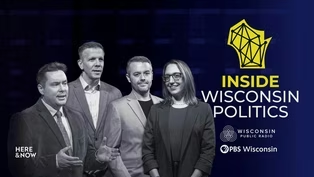
>> President Trump's executive order for citizen voting lists and preventing the Postal Service from mailing any ballots to people not on those lists, was among the topics on this week's Inside Wisconsin Politics.
The WP and PBS Wisconsin podcast, where you can hear the state's most experienced political reporters break down the news.
It features PBS Wisconsin's Zac Schultz, WP Shawn Johnson Anya van Wagtendonk and Rich Kremer.
Here they are on the Trump executive order.
>> So I think what a lot of people would be rightfully wondering is, is this going to happen?
Is this something that is likely to happen in Wisconsin specifically?
look at when these kind of things come out of Trump White House specifically, is what is the reaction for politicians in Wisconsin?
We saw universally all the Democrats, including Governor Evers, use a profanity online to describe his reaction to this.
And we didn't see anything from Republicans.
And if this had a prayer or a chance of actually being legal or valid in Wisconsin, there would have been some of the usual Trump supporting Republicans that would have come out and said, yes, thank you, President Trump.
It's about time.
I didn't see any of that.
Maybe somewhere it was put out and I missed it.
But the overall reaction was a lot of crickets from Republicans.
That signals most election observers not legal in Wisconsin.
Unenforceable in Wisconsin would remove the right to vote for absentee ballots.
We have.
You can register on day of.
There's just so many things that do not apply to how Wisconsin elections are run.
Barring the fact that it's not even legal constitutionally across the rest of the country, according to every election expert that we ever talked to.
I mean, Shawn, you've covered this just as long.
It's not possible for the federal government to dictate how elections are run.
That's done by the states.
>> A heated Wisconsin Supreme Court debate Thursday night between the two candidates running to be placed on the high court.
It featured appeals court judges Maria Lazar, the conservative, and Chris Taylor, the Liberal candidate.
They squared off just days before next Tuesday's election.
For reaction to the debate, we're joined by U.A.W.
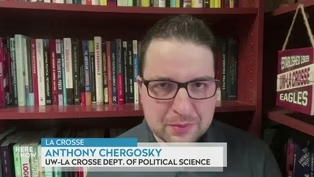
La Crosse, political science professor Anthony Chergosky.
And thanks very much for being here.
Thank you.
So does a debate performance sway people to vote in this election one way or the other?
>> I think we're a little late in the ball game for that.
After all, a number of people have voted by mail.
They have voted early.
And even if they are planning to vote on Election Day, they may well have already made up their mind.
Still, I think debates are symbolically important as a ritual in democracy.
I think it matters for candidates to show up face to face in an unscripted environment and have to defend their positions.
Sometimes debates can sway voters, sometimes not.
But either way, I think debates matter.
>> That said, what do you think the candidate's performance in this debate?
>> Well, this was a heated debate.
I thought that the candidates really sought to draw contrasts between themselves and their opponent, and whether it was on abortion or the issue of voting, or just the general topic of judicial activism and judicial philosophy, and the way that someone's personal views may or may not end up influencing their opinions.
This was a heated debate, with plenty of contrasts expressed between the two sides.
>> Speaking of judicial philosophy, let's take a listen to one of the exchanges about that last night.
>> I do not intend to follow any mandate or agenda or to legislate from the bench.
I am going to actually look what is there.
When people come in front of my court, they they know two things.
One, I always treat them with respect.
And number two, they always have a fair and full opportunity to be heard.
And I decide the case only on the law and the facts.
Judge Lazar is the only person in this race who has brought an extreme right wing political agenda to the bench.
She has refused to follow precedent.
She ruled to release personal private voting information to a right wing group that tried to overturn our election.
Thank goodness she was reversed by the state Supreme Court.
She has been reversed repeatedly because she refuses to follow the law.
>> So in recent cycles, the partizan veil has really been lifted in these races.
How do election experts like yourself regard that as good or bad?
>> We're in a really strange era in these state Supreme Court elections because it's this weird, murky middle ground right now where the parties are deeply involved.
The justices often accept the support of the political parties, but they also want to be clear that they will have some sense of independence.
>> So in the next back and forth that we're going to listen to, the candidates were answering to how they would have voted when, last summer, the Liberal majority invalidated the state's 1849 abortion ban.
Chris Taylor said she would have voted with that Liberal majority to invalidate the ban.
Maria Lazar would not say how she would have voted.
>> There is no one more extreme ever to have been to be a candidate on issues of reproductive health care than my opponent.
She called the overturning of Roe versus Wade very wise, and you can look it up on television.
She said it right on television.
She said she was likely to vote to support.
I'm going to respond.
I did not say I was likely to vote.
I did not respond ever, in that regard.
And what I said about Dobbs, which is the decision that overturned Roe versus Wade, is I said it was good that it brought that national ban and put it back into each individual state.
>> So, as we've said, the abortion portion of the debate was really extremely heated.
But how would abortion come before the court again?
>> Well, Maria Lazar mentioned that after the Supreme Court overturned Roe versus Wade, it significantly empowered states to make a lot of judgments about abortion that they previously would not have been able to make.
When Roe versus Wade was the law of the land.
So we might see a future state legislature here in Wisconsin, a future state legislative majority or a future governor try to take certain actions on the issue of abortion.
And in that case, the Supreme Court could very well enter the picture in reviewing actions that the other branches take on abortion.
>> What are other important cases that will come before the court in the next year or so, and how does the balance of the court inform how these are going to be decided?
>> We may continue to have divided government in Wisconsin, divided control of the executive and legislative branch, pending the outcome of the November midterm elections.
And when you have divided party control of the legislative and executive branch, the courts can really enter the picture as power players in sorting out disputes and sorting out gridlock between those branches.
Plus the 2020 presidential election, we know that Wisconsin is often at the center of legal battles surrounding election.
And then if we go out even further, think redistricting come 2030, the census, and then the redrawing of the maps shortly thereafter.
>> Great.
Well, Anthony Chergosky, thanks very much.
>> Thank you.
>> We're now just four days away from the spring election with justice for Wisconsin Supreme Court on the ballot.
Liberal candidate Chris Taylor has held a commanding fundraising lead over the conservative candidate, Maria Lazar, with most of that money being poured into ads on TV and online.
Now, while this election has held a lower profile than the last two Supreme Court elections, as "Here& Now", senior political reporter Zac Schultz tells us on Tuesday, this race will likely come down to the get out the vote efforts of each campaign.
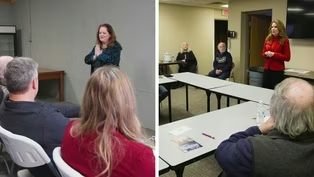
>> It's a Saturday morning in March, and a crowd of volunteers is busy filling out postcards at the GOP headquarters in Appleton.
>> Address and then sign your name.
Right.
A little something about Lazar or vote on April 7th.
We really got to get out the votes.
voters to support Maria Lazar in the Supreme Court election.
Pam Van Handel is the chair of the Republican Party of Outagamie County.
She says handwritten postcards have a personal touch and are more likely to be read than a glossy campaign flier.
>> So what we're doing is we're looking for people that are more likely to go out and vote in these smaller elections, because it is tough to get people out to vote.
So that's our goal here.
So we get a list from the Republican Party of Wisconsin, and we tell them, give us the ones that are really going to go out and vote because we really need them.
April 7th.
Colin Roberts, a member of the Milwaukee County Dems, is knocking doors for Chris Taylor.
>> Oh, okay.
Could I ask who you plan on voting for?
>> The Democratic okay.
>> Yeah, yeah.
So yeah.
Chris Taylor.
>> Technically Supreme Court elections are nonpartizan and candidates use labels like conservative or liberal instead of Republican or Democrat.
But in reality, the Democratic and Republican parties of Wisconsin each donate millions of dollars and coordinate thousands of volunteers in the get out the vote effort.
>> I just think going everywhere is the key and talking to people.
>> Hello, ma'am, I'm Chris Taylor, so nice to meet you.
So nice to meet you, Cornelius.
Oh, you have my vote.
Oh.
>> Thank you.
The Liberal candidate has won four out of the last five Supreme Court elections, flipping a court that in 2019 had A52 conservative majority.
If Taylor wins, Liberals will hold A52 majority.
>> How many of.
You are fired up to protect our democracy?
All right.
>> We are looking at a court that is now 4 to 3.
When I win, it will stay 4 to 3.
We're not changing its composition, but the three votes are so very important.
>> Republicans around the state have expressed worry the backlash to Donald Trump's presidency and political realignment have led to this losing streak.
>> I don't know if it's impacted morale.
What I will say is this I think that the state of Wisconsin is looking at these races and they're asking who's running and why people are running and for what reason.
And when I look at this race, the reason I am running is because I want to be someone on that court who represents the law for the state of Wisconsin.
>> Taylor wants to make sure her supporters don't get complacent with the winning streak.
>> There's four more state Supreme Court elections coming up after mine.
No one should take anything for granted.
This court can change very quickly, but if I am able to get elected, there will be a pro-democracy majority on the court until at least 2030.
>> In their wins.
Rebecca Dallet, Jill Karofsky, Janet Protasiewicz and Susan Crawford each received 55% of the vote.
The 1 conservative victory in this streak was in 2019, when Bryan Hagedorn won by less than 6000 votes, half a percent.
That was a low turnout election, with a million fewer voters than last year.
Hagedorn was outspent and written off by most election observers who expected to see him lose easily.
It's no surprise Lazar hopes this election ends up following the same pattern.
>> Well, secretly, yes.
So the parallels are there.
I think that through my entire career, people have underestimated me.
It's sort of been a theme that they don't think someone a little shorter, a little, little softer spoken can be as strong as steel.
And I am.
And in this race, I think that's important too.
People think that, you know, it's written off, it's a done deal and it's not.
>> Taylor is aware of the Hagedorn comparisons.
>> I won't rest until April 8th, the day after this election.
I take nothing for granted.
This is going to be a hard, competitive race.
I will need every vote that I can get.
I need all the help that I can get from the people.
>> The state of.
>> Wisconsin this weekend will feature the final push for get out the vote efforts.
>> I really feel like the people now are really getting involved at this level, and we're getting more signs out.
We're getting we're just really getting the grassroots going on.
>> With volunteers knocking on doors and reminding their supporters to vote on Tuesday.
location?
>> Yeah.
The pavilion, I can see it.
>> Reporting from Appleton.
I'm Zac Schultz for here and.
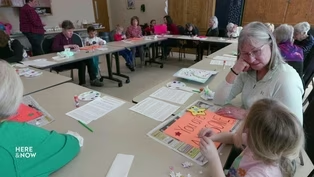
>> Now in the ongoing struggle for more care programs for older adults as well as young children, some communities in Wisconsin are turning to an approach that combines the two different age groups into the same programs.
As Steven Potter reports, the result has benefits for both old and young, and the idea is gaining traction.
>> Hi, how are you today, Owen?
Remember me?
Yes you are.
>> Like elsewhere in the country, Wisconsin is facing a crisis of care on two fronts.
First, the need for child care continues to outpace availability.
Providers say families of 30,000 children across the state can't find childcare.
This problem is particularly bad outside of larger cities, around 70% of rural Wisconsin is classified as a child care desert.
>> Textbook of a broken market.
It's just not working.
>> There's also a significant need for more care and more social connection for older adults.
>> Social isolation can increase someone's risk for dementia, for heart disease, diabetes, depression.
>> Already under strain, the elder care industry in Wisconsin is bracing for increased demand as the number of residents 75 years old or older is expected to grow by more than 40% by the end of the decade.
>> You need some help?
>> Yeah.
>> Given that both the child care and elder care industries in Wisconsin are facing similar struggles, largely based on employee shortages, several communities are bridging those gaps with something called intergenerational care.
>> Intergenerational care.
generations coming together under one roof.
You know, sometimes it might be in a more health care based setting where there's a nursing home and there's younger generations, like a preschool in the same facility, or it can kind of be a little bit less formal and be in community centers.
>> Or Suzanne Morley of the Wisconsin Institute for Healthy Aging says intergenerational care programs and facilities are increasing around the state.
>> In the past five six years, maybe even more and longer.
There's been a lot of interest in intergenerational programing.
There's a lot of research out there that's been coming out about the benefits of intergenerational programing and the benefits not only for older adults, but also for younger generations.
>> Intergenerational care activities vary from place to place.
One program may have older adults visiting young children for reading time, and another program may have high school students helping seniors with technology.
All of these programs bring these groups together for social connection, play, and learning.
>> I think there's a lot of momentum and excitement around intergenerational programs.
>> Paula Drew of the Wisconsin Early Childhood Association has also noticed an uptick in interest in intergenerational care, and for good reason.
>> Yeah.
>> I think both our youngest and our oldest tend to sort of live in the moment more than us, sort of in the middle.
Our seniors have a lot to give in terms of their skills, and they can put those skills to to use with young children who really are starving for that one on one attention.
And that does so much for their brain development.
>> And the older set also sees a boost.
>> For older adults.
There's lots of health benefits.
There's research that shows that can improve cognition.
So helping with things like staving off dementia and cognitive impairment, it can also increase their self-confidence and their self-efficacy if they're interacting with younger generations, it can improve health outcomes.
It can actually lower blood pressure.
>> There are several programs across Wisconsin already, and new ones are on the way.
>> I think this effort is really just an extension of what we already know works, and we already know has all these benefits.
>> In Walworth County.
Maddie Sweetman is with the Groundswell Collective, a grassroots organization pushing for combined daycare and older adult facility in an empty wing of a county run nursing home.
>> We all sort of know what it feels like to have that isolation and be sort of stuck where we are, and I think rural communities can suffer extra from that.
And so intergenerational care like this would bridge some of those gaps.
>> The small rural community of Plymouth in Sheboygan County has seen these benefits for more than a decade.
>> It's really about bringing people together and creating connections between people.
>> Meghann Weeden runs generations, a nonprofit community center.
They're geared towards seniors that partners with a daycare center on site.
>> Creating a community inside the community where people can get support and feel valued and seen and heard.
It gives people a reason to get out of bed in the morning.
>> And then you are going to make a Stein.
>> Doreen Salkowski is a retired teacher who now volunteers at Generations Community Center.
>> I love it, I'm.
I feel like I'm back in the classroom again.
Everybody benefits.
The community benefits.
They're able to see the young people as they're growing, interacting more with the older people, respecting them more.
>> Isolation and loneliness is a nationwide, worldwide issue.
So by creating more intergenerational locations, we're breaking down those barriers and just helping everybody find those connections.
>> Reporting from Plymouth.
>> Oh, I like that one.
>> I'm Steven Potter for "Here& Now".
>> For more on this and other issues facing Wisconsin, visit our website at PBS Wisconsin Dot and then click on the news tab.
That's our program for tonight.
I'm Frederica Freyberg.
Have a good weekend.
>> Funding for "Here& Now" is provided by the fund for Journalism and Friends of PBS Wisconsin.
 New
NewAnn Jacobs on a Nationalized Voter List and Mail-in Ballots
Video has Closed Captions
Clip: S2400 Ep2438 | 6m 15s | Ann Jacobs on an order to create a national voter list and restrict mail-in ballots. (6m 15s)
 New
NewAnthony Chergosky on the 2026 Wisconsin Supreme Court Debate
Video has Closed Captions
Clip: S2400 Ep2438 | 5m 57s | Anthony Chergosky on the importance of a debate between Maria Lazar and Chris Taylor. (5m 57s)
 New
NewHere & Now opening for April 3, 2026
Video has Closed Captions
Clip: S2400 Ep2438 | 1m 4s | The introduction to the April 3, 2026 episode of Here & Now. (1m 4s)
 New
NewInside Wisconsin Politics: A Voting by Mail Executive Order
Video has Closed Captions
Clip: S2400 Ep2438 | 1m 45s | Inside Wisconsin Politics on an executive order calling for a national voter list. (1m 45s)
 New
NewA Movement to Connect Generations Takes on a Crisis of Care
Video has Closed Captions
Clip: S2400 Ep2438 | 6m | Communities in Wisconsin create intergenerational care programs for adults and children. (6m)
 New
NewWisconsin's 2026 Supreme Court Candidates Get Out the Vote
Video has Closed Captions
Clip: S2400 Ep2438 | 5m 16s | Partisan efforts in the 2026 race for Wisconsin Supreme Court consider long-term control. (5m 16s)
Providing Support for PBS.org
Learn Moreabout PBS online sponsorship
- News and Public Affairs

Top journalists deliver compelling original analysis of the hour's headlines.

- News and Public Affairs

FRONTLINE is investigative journalism that questions, explains and changes our world.











Support for PBS provided by:
Here and Now is a local public television program presented by PBS Wisconsin