
March 27, 2026
3/27/2026 | 55m 28sVideo has Closed Captions
Bill McKibben; Hamidreza Mohammadi; Chuck Klosterman
Bill McKibben underscores the urgent need to transition away from oil. The brother of Nobel Peace Prize laureate Narges Mohammadi, Hamidreza, discusses the risks facing Iran's political prisoners. A special CNN investigation reveals how widespread intimate partner violence has become. "Football" author Chuck Klosterman outlines the sport's importance to American culture, and its eventual downfall.
Problems playing video? | Closed Captioning Feedback
Problems playing video? | Closed Captioning Feedback
March 27, 2026
3/27/2026 | 55m 28sVideo has Closed Captions
Bill McKibben underscores the urgent need to transition away from oil. The brother of Nobel Peace Prize laureate Narges Mohammadi, Hamidreza, discusses the risks facing Iran's political prisoners. A special CNN investigation reveals how widespread intimate partner violence has become. "Football" author Chuck Klosterman outlines the sport's importance to American culture, and its eventual downfall.
Problems playing video? | Closed Captioning Feedback
How to Watch Amanpour and Company
Amanpour and Company is available to stream on pbs.org and the free PBS App, available on iPhone, Apple TV, Android TV, Android smartphones, Amazon Fire TV, Amazon Fire Tablet, Roku, Samsung Smart TV, and Vizio.

Watch Amanpour and Company on PBS
PBS and WNET, in collaboration with CNN, launched Amanpour and Company in September 2018. The series features wide-ranging, in-depth conversations with global thought leaders and cultural influencers on issues impacting the world each day, from politics, business, technology and arts, to science and sports.Providing Support for PBS.org
Learn Moreabout PBS online sponsorship>> Hello, everyone, and welcome to "Amanpour & Co."
Here's what's coming up.
>> The little excursion of pretending that we didn't need to worry about climate change is over.
>> As the war in Iran sparks a global energy emergency, is the world finally waking up to the dangers of fossil fuel dependence?
I ask environmentalist Bill McKibben.
Then, trapped between a violent regime and falling bombs, Iran's political prisoners face Iran's political prisoners face grave risks.
I speak to the brother of activist and Nobel laureate Narges Mohammadi.
We worry about going to our car late at night, but we don't worry about who we lie next to.
I didn't realize I had to.
Two years after the abuse of Giselle Peliko made headlines, a special investigation on just how common these crimes are.
We meet the brave women coming forward.
Also ahead, the power and grip of American football.
Chuck Klosterman speaks to Michelle Martin about his new book and how a country's obsession became part of its culture.
♪♪ is made possible by And by contributions to your PBS station from viewers like you.
Thank you.
>> Welcome to the program, everyone.
I'm Christiane Amanpour in London.
Even if America and Iran do find a diplomatic end to this war, the long-term costs to the climate are already clear.
New analysis finds that just two weeks of this war has released 5 million tons of carbon emissions.
That is a lot.
It's according to the Climate and Community Institute.
Iran's continuing chokehold on oil and gas supplies has sent prices skyrocketing.
Some Asian nations have declared energy emergencies.
The head of the IEA says the crisis is worse than the oil shocks of the 1970s and the gas emergency after Russia's invasion of Ukraine combined.
So surely the case for renewable energy is more urgent than ever.
And yet, throughout his second administration, Trump and his cabinet have been pushing in the opposite direction.
All of these predictions made by the United Nations and many others, often for bad reasons, were wrong.
They were made by stupid people that have cost their countries fortunes and given those same countries no chance for success.
If you don't get away from this green scam, your country is going to fail.
To appease a climate cult, we have imposed energy policies on ourselves that are impoverishing our people, even as our competitors exploit oil and coal and natural gas and anything else, not just to power their economies, but to use as leverage against our own.
In the latest climate shock, the Trump administration says it'll pay nearly a billion dollars to scrap planned wind projects and invest in fossil fuel development instead.
This, as other countries look to accelerate a shift into renewables.
Bill McKibben is a globally recognized author and environmentalist who says the Iran war is another reason to quit oil, and worries about America's chief adversary, China, winning this race.
Bill McKibben, welcome to the program.
Good to be with you as always.
You know, as I watch this unfolding and this massive spike on oil prices and gas prices and the danger to that infrastructure, I come back to this word, addiction to fossil fuel.
And I wonder if this is the proof positive needed, if any, was ever to happen in front of us, that renewables potentially would have avoided this crisis.
You know what they say about addicts hitting bottom, and that's what it takes to start getting out of a hole.
Maybe, maybe this is something like a bottom.
Clearly, Trump and the Gulf states are very worried that it is.
The reason that they're backing off now from this war as desperately as they can is because they're suddenly realizing that $120 a barrel oil is convincing people all over the world that they want an EV in the garage, and that they'd a lot rather have a solar farm than a gas-fired power plant.
Look, if you have to rely on Donald Trump for your energy supply, someone as erratic and unstable as the current American leader, wouldn't you rather rely on the sun, which has a pretty good record of coming up more mornings than not?
- So, people will say, "Yes, that makes perfect sense, but how quickly can we get all these alternatives that we need?"
I mean, let's face it, Donald Trump and successive administrations have rolled back a lot of the progress, mostly Republican administrations, and you've got the European crisis, where even the EU has had to sort of walk back some of its green economy.
Talk to me about how one can actually make good, like a... One can do this at speed, as the Chinese are proving.
They've built so much clean energy so fast that they're sitting pretty as this saga unfolds in the Middle East.
It's really a story of the last 36 months, this explosion of renewable energy, first in China, but also increasingly around much of Asia, large parts of Europe.
Look at the Spaniards.
They're the one part of Europe that feels free to flip-trump the bird because they have enough sunshine to power their economy.
Everybody's figuring this out.
It's not just that it's geopolitically sound.
It's not just that it actually does something about the climate crisis, the biggest problem that we actually face.
But it's also cheaper.
That's the real... Even when oil wasn't $120 a barrel, it was still cheaper to use sun and wind to produce energy than to use oil and gas.
So it's really possible to do this.
The fossil fuel industry has been fighting, now, a kind of rearguard action to prevent it from happening.
In the U.S., they've been successful because they were able to elect a climate-denying idiot to the presidency.
But that's not going to last.
It's not even going to last in the U.S., where we've just come through the most wicked heat wave, most anomalous heat wave probably in American history.
The temperature hit 114 degrees Fahrenheit on Friday in March.
It broke the old record for the hottest March temperature in America by 4 degrees.
So look, this little excursion, as Trump calls it, in Iran, and the little excursion of pretending that we didn't need to worry about climate change is over.
We're back where we were a few years ago.
The only difference is we have cheap sun, wind, and batteries that would allow us to make very rapid change.
- I like the way you say "cheap" because most of the anti-renewable, you know, group have said that it's way too expensive, that it impoverishes our economies.
You may have heard it in the lead-in.
Trump has said, you know, "You must get away from this green scam or your country is going to fail."
Give me a reality check on that.
- It's complete nonsense.
I mean, anybody, beginning with the investment bankers who publish regular data on the levelized cost of energy, will tell you that sun, wind, and batteries are the new holy trinity, that they produce extraordinary amounts of very cheap energy that runs all day and all night.
And that's why 95% of new electric generation around the planet last year came from clean, renewable energy.
The oil and gas are old and expensive, and they're getting more expensive by the day.
But even if we reopen the Straits of Hormuz, it's not like they're suddenly going to get really cheap.
The thing that falls in price every year are sun, wind, and batteries because we get better at doing them.
Every time we double the number of solar panels on the planet, we drop the cost another 25%.
So this is clearly the future.
The only question is, can we reach that future before we fully wreck the planet's climate?
And that's why it's so important for people to be demanding action.
We had this big Sunday event across America in September with 500 demonstrations demanding more action.
A lot of those people will be out again at No King's Day this weekend.
Climate will be one of the things that people are talking about.
And we're actually making some progress at the state and local level.
28 states in America have this year introduced legislation that will allow Americans to start using the balcony or plug-in solar that has become so common in Europe over the last 24 months or so.
Virginia just approved plug-in solar.
Vermont is about to.
Utah has already done it.
So even with Washington in the hands of, as I say, idiots, it's possible to make real progress in the rest of the country.
So you've said idiots twice.
I'm going to let you have your own opinion.
But of course, as you know, the MAGA faithful-- hold on, hold on.
MAGA faithful is doubling down.
And even as you speak right now, the US Energy Secretary, Chris Wright, last week used the war in Iran to justify why BP should be allowed to drill deep down in the waters of the Gulf of Mexico.
As I said, MAGA continues to double down on fossil fuels, and Trump has always promised to, quote, "Unleash American oil and strengthen American dominance."
So why are they so adamant?
I mean, President Trump fancies himself as a transactional kind of guy who really wants to get the best deals and negotiate the best deals.
So if, in fact, it's cheaper for America and for the budget not to be paying all this money and all this crisis now, why not go renewable?
He's a deeply transactional guy.
It's just, Christiane, that the transactions are on behalf of him.
When he was running for president, you'll recall that he told oil executives that if they donated a billion dollars to his campaign, he would give them anything that they wanted.
They donated, between actual donations, lobbying, advertising in the last election cycle, about a half a billion dollars.
And that turned out to be plenty.
The president has, for instance, shut down wind farms that were 95 percent complete off the eastern seaboard.
He's now proposing to spend a billion dollars in taxpayer money to buy out the leases of people who want to build new wind farms off the coast just to make sure they don't get built.
These are favors for the fossil fuel industry, and that's the transaction that he's engaged in, while the rest of the world is busy heading in the other direction.
The economic self-sabotage that the U.S.
has engaged in over the last 14 months, as we took technologies invented in the U.S.
First solar cell, 1954, Bell Labs in New Jersey, first industrial wind turbine, 1943, about 30 miles south of where I am at Middlebury College in Vermont in 1943.
Technologies invented in America that we have now handed lock, stock and barrel to our theoretical main adversary, the Chinese.
I don't think there's really a kind of economic self-destruction like that that you can find anywhere in the historical record.
It's amazing the way you say it.
You said our competitors and even adversaries like China, but the EU is now agreeing that renewables are the best investment in the future.
Even nuclear funding and this and that.
And of course the current crises just show how exposed Europe and others are, including as you said the Far East.
But let me just read what the Bulgarian environment minister said.
Do we want to be a petrostate or a petro-union or petro-continent without petro-resources?
It's totally ridiculous.
We have to accelerate our electrification.
But again, the Trump tariffs and all of this and the economic upheaval is putting pressure on this move towards renewables.
Oh, absolutely.
But the EU has had now two shocks in this decade.
The first was the Russian invasion of Ukraine, which cut off their easiest supply of natural gas.
And the second is the closing of the Straits of Hormuz and this huge, huge jump in the price of energy and its availability.
I think any leader with any kind of foresight has to conclude that the time has come to try and be as independent as you can.
And the good news for Europe and everywhere else on the planet is that every country has ample wind and sun to do what they need to do.
This is easiest in Europe because places are so close together that the links from one country to another so that you can get wind off the North Sea into much of Europe and so on, much, much easier even than it is in a sprawling place like the US.
So I think the EU is actually sitting pretty going forward.
They have good engineers, they have experience in doing all of this, and they have places like Spain and Germany and Denmark that have really provided surpassing leadership here.
The place that's in big trouble is the the US because we simply refuse to grapple with the fact that we now have a super expensive energy system and it's not just that we're paying more for gas at the pump which you know I drove past a gas station today that was charging four dollars and nineteen cents a gallon for Americans that's a huge amount of money it's not just that though it's that every transaction in our economy now is carried out with more expensive energy than the rest of the world.
How do we think we're going to make that work?
So I guess my question to you is, what is going to change this?
As you mentioned, the demand for EVs is growing across the United States because of the prices of gas.
It's seen as a cheaper way out.
But, you know, and even I remember listening on the radio when Trump was inaugurated, or maybe just after his election, they interviewed some renewable gas entrepreneurs from -- or rather, renewable energy entrepreneurs, solar farm owners, from the very red state, energy-rich state of Texas.
And they said, "Oh, no, we don't want this renewable business of ours to be slashed and burned under a Trump administration."
So what will it take?
I mean, that's in the red state, the oil state of Texas.
What will it take for people to tell their leaders what they need to do?
- So Texas is a good example.
It's installing more clean energy than any place in the United States even now.
But Trump is successfully slowing it down for the moment.
So what it takes in the long run will be getting Trump and his party out of office.
That begins with the midterm elections.
The move towards the midterm elections begins Saturday in America at No King's Day.
There will be 3,000 or 4,000 demonstrations across America.
It will be the biggest public protest since Earth Day in 1970.
It will be one more signal that Americans are fed up with this.
Lots of people are fed up with it for lots of good moral reasons, but there now are millions more people who are just angry at having to pay more for gas than they can possibly afford for no reason.
- Trump is not up for election again.
Could he not somehow spin this as his own initiative?
Yes, I said this and this and blah, blah, blah, but now look at this crisis.
Let's be the leaders in the renewable energy to ensure America first.
Anything is possible.
But I gotta say, it feels more and more like Trump is one of those old people so stuck in their mindset that they just can't shift with the facts at all.
That's not true of all old people.
We organize millions of people at thirdact.org over the age of 60.
They're coming out to try and stop Trump, not hope that he somehow has a last-minute Saul on the Damascus Road conversion, because I think that it's going to take real political protest to make the change we need.
And just let's say if this had all been taken on board and there'd been a relentless China-like move towards renewables decades ago when it was still possible, where would the U.S.
be right now?
- Well, the U.S.
would obviously be in a much better place economically and politically.
More to the point, the planet would not be as hot as it is now.
And against all the terrible things that are happening on the planet, that remains the really dangerous backdrop here that we absolutely have to deal with.
That's the one thing that there's no coming back from after an election or something.
Our job is to try and do whatever we can to hold the temperature down.
And the good news is that whatever we can, the quick transition to clean energy is also the thing we need to do for our economic future and to stabilize the politics of an increasingly violent and dangerous world.
- Really important last word.
Bill McKibben, thank you so much indeed for joining us.
- Thank you very much.
Have a good day.
- Now, as their fate is decided thousands of miles away, the people of Iran are literally in the dark, grappling with the longest internet shutdown in the country's history.
Voices have been silenced, executions are being carried out according to human rights groups.
And on top of it all, many have grave concerns for their imprisoned relatives, especially those held for their democracy activism.
Nobel Peace Prize Laureate Narges Mohammadi has spent much of the past two decades behind bars.
And just weeks ago, the Nobel Committee said that she was being severely abused.
Her brother, Hamid Reza Mohammadi, joins me from Oslo.
Hamid Reza Mohammadi, welcome to our program.
Thank you.
Thanks for the invitation.
This must be incredibly difficult for you and of course for your sister and the other prisoners inside Iran.
Have you heard anything from her recently or about her condition?
The last time I could speak with my family was two weeks ago.
After Narges was transferred to Zanjan Prison, she has been able to call my sister and my brother.
My brother, when he wanted to talk about the situation in Iran, the attacks and other things, he's not been allowed to have any calls from Nargis.
I think it's a general situation in Iran.
Political prisoners are under a lot of pressure.
They are kept in the dark.
And as you know, the situation in the prisons are really worrying.
She's obviously not a very healthy person.
She's got issues and I'll play something that she told me.
But right now, who are the prison guards?
We hear that revolutionary guards have been drafted in to keep control of the prison.
That food is running out, water is not particularly healthy, no medical attention.
Can you tell us any more about that?
What does your family say about what's happening inside the prisons?
I don't know exactly about the prison in Zanjan, but the reports coming from the families of the political prisoners in different situations, in different cities, all of them say that the guards that used to work there, they are not there anymore.
They are substituted by the Revolutionary Guard, anti-protest and crackdown forces.
And it just shows that they are worried about any uprising, especially inside the prisons.
And under the conditions of war, in the wartime, they are not giving any resources to the prisons, be it medical help or food and drinks.
So, political prisoners are in fact the most vulnerable people in Iran now.
Because on the one side, they don't know what's going on outside the prison.
They are worried.
On the other hand, they are not getting even food and water that was meager even before the war and now it's become worse.
So, Hamid Reza, let me ask you about her actual health as far as you know it.
Because she was reported by the Nobel Committee to have been badly kicked and bruised just recently, kicked and beaten up just recently.
And when I spoke to her when she was out of prison on furlough in December of 2024, so that's more than a year ago now, this is what she told me about her treatment back then.
I was beaten up very badly.
My whole body was covered in bruises and injuries.
I urged them to send doctors in.
There were 24 bruises on my body.
As I was beaten up by the guards, we started chanting loudly.
They started hitting me on the chest, as I was supposed to go for an angiography.
My arteries were blocked, yet they were beating me on my chest.
So that was nothing accidental.
It was deliberate on their part.
I mean, it really just sounds awful.
It must be very painful for you.
Her husband, Tariq Rahmani, has said, "We've entered a dark tunnel.
There's no telling when we'll come out of it."
Yeah, it is not the first time Narges has been beaten in the prison.
When she had a sit-in in the prison as a protest, she was thrown to the doors and windows.
She had lots of cuts and as she said she was beaten.
And also this time she was dragged down by her hair.
She was beaten repeatedly when she was being arrested and then after being transferred into the car to take her to the Mashhad intelligence agency, she was beaten in the car also.
And one of the... she had only two contacts with my family at that time.
One of them was at the very beginning and she talked with my family and told them to make an official complaint against the security forces.
And after that she was not allowed to make any contact.
Wow.
But those who were with her in the prison and they got out, they urged the family to contact anyone possible to say that Narges has had heart problems and her blood pressure was not stable.
She was transferred to the hospital for just a check-up and she was returned back to the prison.
In the hospital, without the supervision of the family or a lawyer, they have been known to inject political prisoners with suspicious drugs that have caused complications later.
During the protests, the authorities came into the hospitals and pressured doctors and removed patients from beds.
In the so-called 12-day war, Israel hit the Avin prison.
And now Israel and the US are hitting detention centers, police stations, intelligence officers to weaken the Iranian security apparatus.
And human rights groups are saying that if the regime survives, the first people it will turn against are activists, protesters, in other words the people of Iran who may want change.
I agree with this analysis that if the regime survives they will go after their most dangerous enemies, that's the Iranian people.
Because the attacks might stop, but the Iranian people would not stop.
They want change and they are frustrated, especially after the massacre that happened in January.
They don't want this regime to remain.
So the regime, more than thinking about what would happen with Israel and the United States, they are planning on a kind of purification of the atmosphere in Iran.
That means killing all those who were arrested in January protests and those who were somehow activists, leaders, who are in the prison, who have been in the prison for a long time.
So I don't see a very good outcome if the regime stays in power and that seems to be the case, at least for now.
Hamid Azhar, thank you so much for being with us and to help really spread the word of your sister's plight and we hope that people will understand what's happening inside Iran.
And I just want to end by reading what her children read out when she was awarded the Nobel Peace Prize in 2023.
She wrote, "I write this message from behind the high, cold walls of a prison.
The Iranian people, with perseverance, will overcome repression and authoritarianism."
Next, it was the case that shocked the world.
Two years ago, Giselle Pellicot waved her anonymity and put a global spotlight on the horror of being drugged and repeatedly raped for almost a decade by her husband and at least 50 other men he recruited.
Going public made Pelico a global symbol of strength and survival.
It also inspired other women to come forward with their own stories.
And there are so many of them.
This investigation by Saskia Van Dorn exposes what's emerged as an epidemic of drug-facilitated sexual abuse, powered by a global online network connecting abusers.
And just a warning before we begin, it's a report that contains accounts from survivors of sexual assault and abuse, which some viewers will find distressing.
Those who appear on camera gave their consent and we respected the wishes of those who asked to remain anonymous.
Emergency.
Warden connecting.
Go ahead, call the watcher, emergency.
I've just heard from my daughter.
She's on her own in a house with four children and has just learned she's been drugged with her son's sleeping medicine.
We worry about his coming behind us, walking down the street.
We worry about going to our car late at night, but we don't worry about who we lie next to.
I didn't realise I had to.
Zoe Watts may never know if the videos her husband made of her being raped were ever uploaded online.
She met him when she was 17.
He's now serving 11 years for rape, sexual assault by penetration and drugging.
I knew that he wanted to have a conversation because we'd had a church service that Sunday.
He reeled off a list of his wrongdoings to me, as if it was, you know, a shopping list.
"I've done this, this, this, this, this and this.
"I've been using our son's sleeping medication "to put in your last cup of tea at night, "to tie you down, take photographs and rape you."
And I think I just went into shock.
Zoe kept the abuse secret for a few months as she grappled with what had happened to her.
Speaking out only after a severe panic attack, her mother then called the police.
There were some times that I thought, "This isn't right."
But what would it mean?
What would our family look like?
Their children would be without a dad and there would be a reputation and my boys would grow up having a reputation and they'd know what their dad was doing.
I've noticed you haven't used the word rape a lot in anything.
Tell me why.
Because it just doesn't.
I don't know, it's like one of those things really.
I really struggle with that, to say that that's what's happened.
It's like people can say it to me but I just don't think... You know you're not alone.
Yeah, yeah, sadly.
Huge numbers of explicit sleep videos are being uploaded online by users who claim it's non-consensual.
One website profiting from this is motherless.com.
Last year we began investigating a porn site that gets over 60 million visits a month, focusing on the thousands of videos featuring women who appear unconscious during sex acts.
Most of its users are based in the US.
It's home to so-called 'sleep content' with hundreds of thousands of views.
One popular hashtag is #eyecheck, a way of proving a woman is asleep.
We created a fake name and soon got into a private Telegram group dedicated to sharing sleep content with almost a thousand members.
One day, a man in the group we're calling Piotr, not his real name, DM'd me.
Piotr admitted to me that he had been crushing pills into his wife's drink to rape her in her sleep.
Without encouraging him, I tried to find out how he was managing to do this.
Who was he?
Where was he?
Even when women come forward, proving it can be nearly impossible.
Some drugs leave the body within 12 hours.
Survivors often only realise much later what happened.
And even with the courage to speak out, there are still countless roadblocks when it comes to reporting to police or bringing a legal case.
Amanda Stanhope didn't know her partner had been abusing her for five years.
The police had to look through all these videos.
And what did they make of them?
The one where I was absolutely horrified and he'd performed a sexual act on my face whilst I was unconscious and it was completely clear and the police looked at this one and I thought, there's the evidence and the police said to me, well we can't use that, that isn't clear evidence because it looks like you're pretending to be asleep.
Her former partner was charged with multiple counts of rape and sexual assault.
He took his own life before the case could go to court.
While talking to survivors, the man I was DMing continued to message and send me videos.
It's made me even more determined to try and meet him, to get him in person.
So I'm going to send him a message now, and I'm going to see if he would meet with us.
By now, we'd worked out he was in Poland, and we knew roughly where he lived, but he refused to meet.
And then, a tip.
He let slip that he was planning to attend a party.
[keyboard clacking] ♪ ♪ - That's him.
I recognize him.
- So we're inside the restaurant, and I've just seen him dancing with her.
And at the start of this investigation, all of these men were faceless.
And so seeing him tonight has just really brought home the fact that this is happening in real life.
The man who had been messaging me day and night was only a few feet away, oblivious.
I'd come to see if he was real and there he was with his wife, the same people I saw in the videos.
We couldn't approach Piotr's wife without potentially putting her in danger so we reached out to police about our findings.
The Telegram group we infiltrated eventually disappeared but it's a pattern authorities know well, one goes offline another soon resurfaces.
We reached out to both Motherless and Telegram but did not receive a response.
As campaigns by German journalists to shut down Motherless and strengthen moderation on similar platforms continue, videos of women who appear to be abused while unconscious are still being uploaded and US safe harbour laws largely protect the site from liability.
In the end it all comes back to Giselle Pellicot, the survivor whose trial shocked France and drew global attention.
With astonishing dignity she has taken hold of her own harrowing experience.
In reporting this case we have spoken to multiple survivors who say they were drugged and raped by their husbands and many of them see you as a source of strength.
With your permission I'd like to read you some of the messages that these survivors have sent to me to read to you.
One survivor, her name is Amanda Stanhope, she lives in Wigan.
Her strength inspired me to speak out.
She broke the silence and shame, so many survivors are forever grateful to her.
I'd love to say thank you.
If she can do it, then so can I'm going to cry.
It's beautiful.
These are the testimonies that move me, of course.
But it's beautiful to think that they found this strength.
I was able to transmit this to them.
It's a win.
Because we have to be supportive of everything that's happening.
Because if we stay in our corner, we'll never make our consciousness evolve.
And I say, "Well done, ladies.
Well done."
Don't be ashamed of having done it.
All women must be able to do this, even if it's very difficult, even if it's very complicated in their heads.
But they will succeed.
It takes time.
It can take months, days, maybe even years, but they will eventually get there.
A truly horrendous and criminal situation.
And if you've been affected by any of the issues discussed in this important report, for help in the United States, call the National Sexual Assault Hotline at 800-656-4673 or chat 24/7 at online.rain.org.
Internationally, UN Women and the PIXL Project provide a directory of agencies.
Next, it's the game that has transcended sport, becoming central to many American relationships, traditions, and holidays.
But why does football hold such a powerful grip on the country?
Our next guest has a theory, which he's sharing in a new book appropriately titled "Football."
Cultural critic and author Chuck Klosterman joins Michelle Martin to explain why it matters so much to America, although it may now have an expiry date.
- Thanks, Christian.
Chuck Klosterman, thank you so much for joining us.
- Thanks for having me on.
- You've written, what, a dozen books now?
- This is 13, I guess.
- This is 13, about like all kinds of things, like there's sex, drugs, and Cocoa Puffs, but what if we're wrong, about all kinds of things.
So why football?
- Well, you know, I have been unconsciously thinking about football for about 45 years now.
It's not just that football is the most popular sport.
It is really more popular than all the other sports in America.
I mean, it dominates television to really a nonsensical degree.
Like in 2023, 93 of the 100 most watched broadcasts in the United States were pro football games, and then three more were college games.
There's no corollary to this in other countries.
Even in countries where much of Europe's soccer is dominant in a way that it would seem to mirror our relationship to American football, but not really, not with this all-encompassing magnitude.
Where in the United States, even if you hate football, you somehow collide with it.
And I just think that in some ways, the irony that it is so beloved in the United States and really unplayed elsewhere is also a meaningful thing.
Because I mean, when you start thinking of ideas like just the concept of American exceptionalism or whatever, regardless how you feel about it, the manifestation of this is the idea of a sport that is hyper-popular in one place and unplayed in most of the world.
So let's get into the meat of your argument.
You open the book with this claim, "Football is the clearest projection of how people of the United States think and of what those people value, even and perhaps especially when football is something they actively dislike.
The role it plays in the shaping of our contemporary reality is both outsized and underrated.
Say a little bit more.
Well, you know, on the surface, the reason I say it's outsized and understood is because nobody seems to be arguing that football isn't the most popular sport or even the most popular kind of entity in the United States.
Everyone accepts that.
But what is underrated maybe is the gap of football and absolutely everything else with the possible exception I guess of Taylor Swift.
I mean, look at football being invented kind of post-Civil War and then it evolved sort of on its own in its own way for, you know, 50, 60, 70 years and then intersects with the rise of television in the 1950s.
This is purely by happenstance.
I mean, obviously the creators of football had no idea for this coming medium.
The people inventing television did not have football at the front of their mind, but that marriage was so ideal that football in so many ways is the ideal product to experience the platform of television, the medium of television.
That as television became sort of the dominant sort of shaper of the last half of the 20th century, football kind of just came along with that.
And a lot of the language we use, and just politics and everyday language, comes out of football.
The idea that football has this kind of militaristic base imbues a lot of its meaning.
I don't know if this will be true for football moving through the 21st century, but if you were looking at the last half of the 20th century in the United States, and you can only use one thing to describe what has happened or what the ethos was, football is probably the best choice.
Yeah.
Do you argue that football pushes against ideas that we claim to value?
Democracy, creativity, individual expression.
And if you kind of think about it, you're like, yeah, you're right.
I mean, discipline, the team, you know, basically subsuming your own individual desires and interests for the whole.
It's almost militaristic, as you point out.
The contradiction is that when you explain it like that, or if I were to explain it like that, it seems real problematic in a way, right?
Seems almost what we're saying is the qualities of football that people love are the things that they have been socialized to believe are antithetical to what you should want if you're an enlightened person.
But that is to some degree true.
I mean, when we watch basketball, for example, you watch the NBA, it's kind of almost a creative endeavor for the individuals.
You're actually seeing these guys, and you're seeing them use this sport to sort of reflect who they are.
Football shuns that.
Football shuns the individual.
It's all about the collective.
You know, the idea of athletes, you know, we're in the kind of the player empowerment age, where the idea of the players should have more say on sort of how the league operates, how the revenue is shared.
But again, football's not really like that.
Football has this hierarchy where a play comes from the press box, down to the coach on the sideline, sent in through a radio, in code, the quarterback looks at a wristband, decipher the code, tell the other 10 guys.
It's like, it is really a kind of a corporate structure in a sense.
- Excuse me, it's a cartel.
The fact it's a cartel, the fact is it's a closed universe where the people who are already in it decide who else gets to be in it.
I mean, they literally kind of vote the ownership in and can decide, for example, that there will never be another team like the Green Bay Packers, which is owned by the community.
That's a cartel, sorry.
- I mean, yeah it is.
And we're accustomed to using a word like cartel to associate with like drug lords, right?
Or when we say something is undemocratic, that football has in some ways, like, you know, it's always dangerous using words like fascist, right?
Because there's different people, different ways of, of, of using the word.
Yeah, well that's not today's argument.
But I'm saying that the literal definition of fascism, which is like an authoritarian situation where violence is part of it, and all of these things, that is what football in many ways reflects, but it works in football.
And this is sort of one of the ironies, is these things that we're kind of told, that we're supposed to see as problems, and we would see them as problems in almost every other walk of life, can be accessed through this simulation, through this game.
And I think it allows people sort of to somehow, in a weird way, deal with reality by having this unreal world.
You describe football as a socially sanctioned space where pain, domination, and physical sacrifice aren't just tolerated but celebrated.
No sport sort of adopts forward-thinking maturity as much as football.
The idea of through radios.
It was a radical idea.
Any technical or ideological innovation is immediately adopted by football.
And yet, in so many ways, it is a sport mired in the past, at least from a value perspective.
The way a football coach can act, for example, would not be acceptable in almost any other line of work.
The thing that guys, shoulder grabbing, things that are kind of accepted, that we assume will happen, the idea that, well, it's a real application of physicality and to some degree violence, which for the most part, people are able to separate themselves in life.
Not everybody, but most people are able to live a life where physicality does not really confront them.
And football says, "Well, those things are still real."
These things that we have managed to socially move away from, the idea of sometimes the power relationship in sports, where it is simply a matter of mass and speed against something else, technique and all of these things come into play.
What I'm saying is a lot of these ideas, which used to be part of just day-to-day life, for many, many Americans, the idea that physicality being part of their life and sort of the consequences of all this, that has been removed, but we still hunger for them.
Let's talk a little bit more about television, the role that television plays.
You say there's something psychologically mysterious about the way football is presented on television.
Everything about it contradicts the normal definition of entertainment.
What it suggests is that televised football combines a host of qualities we're conditioned to consider undesirable, even though we instinctively prefer how those qualities inform the experience.
In other words, we're wrong about ourselves.
I'm sorry for laughing, but I just thought that was so funny.
But what we want from television and what we think we want from television are not the same.
I'm always very interested in the difference between what we consciously say we want and the unconscious desire, right?
So we look at a sport like football in particular.
Now the Wall Street Journal did this big research project where they looked at NFL football games and realized or came to the analysis that in a three and a half hour telecast there's generally 11 minutes of action of actual football being played.
Now, if football was a new sport, we were inventing it and we were pitching it.
And one of the pitches was, "It lasts three hours, but here's the deal.
There's only 11 minutes of action."
People would be like, "No, this is not a good idea.
We're not going... that's a terrible plan."
And you'd say, "Also, we're going to mostly see the game from the same vantage point, midfield downward, where the players are moving horizontal across the field."
It won't be the best way to see it, but it's going to become so ingrained with people that they're going to understand everything about the game in this way.
All of these things seem as though they would be mistakes.
They would be things we would not want.
And yet, as it turns out, 11 minutes of action in three hours is the perfect amount, because there's five seconds of kinetic hyper-violent action, so intense, with 22 people moving independently, things happening that we can hear but we can't see, a real complexity to what has been rehearsed and what's being manifested.
It feels like this super dynamic thing.
But then there's this gap, where we think about what we saw, and what the next play might be, and how this fits into the context of the larger game.
Or, I can look at my phone, I can talk to or something else.
I can drink a beer, I can disengage, think about my life, and then get right back in for the next 5 or 6 seconds.
It actually is how our mind wants to process entertainment.
Which is why I argue that football is probably, I feel pretty confident about this, the best product ever made for television.
And no one could have expected that.
Even at the other sports, as we describe them, you would think that those would fit better.
Those should be what we want.
But what we want and what we actually say we want are often very different.
- There's been in recent years, I'd say maybe the last decade, sort of along the rise of like the Me Too movement and other sort of scientific advances that allowed people to understand the cost, the toll of this on people, as we're understanding more about how the brain works, the impact on the brain.
We're seeing more about, you know, stories about players in their personal lives behaving in a way that is unacceptable, like the violence that we see on the field sometimes translating into interpersonal violence in a way that we find unacceptable.
I'm just curious if you feel that this sort of movement to acknowledge these things is affecting the way people are receiving this?
Well, I mean, this is part of the reason why I sort of have this argument that I think probably in two generations from now, so I'm looking at the year, say, 2060, 2070, I do think that football will probably recede, it won't disappear entirely, but it will recede from the center of the culture.
The idea of it still being the monoculture will be over.
Because I do think that as we have moved into this century, that the personal relationship that used to be part of football in a more tangible way, more people would have either played in high school or knew people who played or their father, or all these things.
I think that that relationship is sort of being almost kind of severed and to some degree politicized in that now saying that you love football now has a meaning in this country that it may have in the past where it was almost saying that some of the things you were talking about someone is saying like, well, yeah, I mean, I'll acknowledge those things are real or whatever, but I miss the world where that wasn't the conversation, you know, what's like, you know, the thing you said, like this new development.
I remember when I was very young, there was this urban myth that like that domestic violence sort of like decreased dramatically during the Super Bowl, like during the four hours of the Super Bowl, domestic violence, you know, just fell through the floor.
That turned out to not be true at all.
But it was already this idea that was actually kind of a forward-thinking idea that somehow that football was a way for people to sort of exercise their violent tendencies by consuming up.
And no one really knows it's that true.
There's certainly a higher rate of domestic violence among football players than the average public.
But that's also a little bit understandable.
You reward someone for being violent for most of their life.
The idea that that can carry over the rest of their life is not unthinkable.
So let me go to something that has actually gotten quite a lot of attention since your book has come out, and that is your prediction that football is doomed.
Not tomorrow, but eventually.
Why is that?
Well, I mentioned at the beginning of the book, it's a big chuck at the end of the book and it's the thing most people are, because it's just it's so paradoxical to people.
I'm saying that this thing that is clearly the most popular thing in the country is due.
But you know, the fact of the matter is, I think it's two things.
I think one is going to be an economic issue.
I think another is going to be sort of the lack of personal relationship people are going to have with the game moving forward.
It's going to only be a mediated TV event.
So when something catastrophic happens economically, the fan base won't care the way that we would care now.
But you know, many people read that section and they point to all the things like, "Well, I don't think this is true.
I don't think advertising is going to change that much.
I don't think it's going to keep..." There's a million arguments you can make against what I said.
I guess my central argument is, how many times in the history of the world has the most popular thing remained popular in perpetuity?
The answer is none.
That has never happened.
That has never happened.
There hasn't been an art form.
There hasn't been a sport.
There hasn't been anything that has been that dominant that just exists forever.
So something's going to happen to football.
It's going to happen because of its size alone.
As society changes, and obviously society will, big objects have a harder time changing than small objects.
They're less flexible.
They're more brittle.
So I don't think it is in any way outrageous to argue that 50 years from now or 60 years from now, the way the world is will be different.
But it just proves how popular football is.
The idea of telling people that the thing you love won't be popular after you're dead, they're like, "No way.
I don't accept that."
Okay.
Well, before we let you go, you end the book by writing, "Some insanities are acceptable.
This one is mine.
It's normal for Americans to have an abnormal relationship to football, and I'm too normal to confront my simplicities.
I want to be controlled.
I like it.
I don't care if it doesn't make sense.
That's the best part.
You know, there are parts of me sometimes I feel like, would I be better off if I didn't care about football, if I had never played football?
You know, all this.
I sometimes think I would be.
I would be.
You know, it is, it consumes so much of my time and my thinking.
So much effort I place into trying to see specific football games, which I then forget about in 48 hours or whatever, but like the next one's coming, so I got to figure that out.
And yet, this is who I am.
You know, I am someone who loves football, and I think there's going to be a time in the future when it won't be this way.
And people are going to come up with explanations as to why it collapsed.
And those are going to be wrong.
So I'm like, I'm going to do a book now so that they can read this book in the future and be like, this is why they cared.
- Okay.
Chuck Klosterman, thank you so much for talking with us.
- Thanks for having me on.
- Over here across the pond and around the world, our obsession is football with the ground ball.
That's it for our program tonight.
If you want to find out what's coming up on the show every night, sign up for our newsletter at pbs.org/amanpour.
Thank you for watching and goodbye from London.
 New
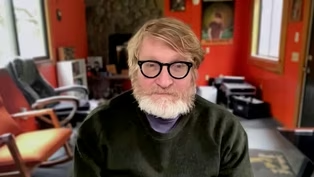
NewAmerica’s Most Popular Sport Is “Doomed.” Here’s Why
Video has Closed Captions
"Football" author Chuck Klosterman outlines the sport's importance to American culture. (16m 54s)
Providing Support for PBS.org
Learn Moreabout PBS online sponsorship
- News and Public Affairs

Top journalists deliver compelling original analysis of the hour's headlines.

- News and Public Affairs

FRONTLINE is investigative journalism that questions, explains and changes our world.












Support for PBS provided by: