
Communities struggle with rebuilding a year after LA fires
Clip: 1/7/2026 | 8m 49sVideo has Closed Captions
A year after the devastating LA wildfires, communities struggle with rebuilding
It has been one year since a series of wildfires set parts of Los Angeles ablaze, killing 31 people. In two of the hardest hit areas, Altadena and the Pacific Palisades, residents are still grappling with how to rebuild their homes and communities. Stephanie Sy reports.
Problems playing video? | Closed Captioning Feedback
Problems playing video? | Closed Captioning Feedback
Major corporate funding for the PBS News Hour is provided by BDO, BNSF, Consumer Cellular, American Cruise Lines, and Raymond James. Funding for the PBS NewsHour Weekend is provided by...
Support provided by:

Communities struggle with rebuilding a year after LA fires
Clip: 1/7/2026 | 8m 49sVideo has Closed Captions
It has been one year since a series of wildfires set parts of Los Angeles ablaze, killing 31 people. In two of the hardest hit areas, Altadena and the Pacific Palisades, residents are still grappling with how to rebuild their homes and communities. Stephanie Sy reports.
Problems playing video? | Closed Captioning Feedback
How to Watch PBS News Hour
PBS News Hour is available to stream on pbs.org and the free PBS App, available on iPhone, Apple TV, Android TV, Android smartphones, Amazon Fire TV, Amazon Fire Tablet, Roku, Samsung Smart TV, and Vizio.
Providing Support for PBS.org
Learn Moreabout PBS online sponsorshipAMNA NAWAZ: Today marks one year since wildfires set parts of Los Angeles ablaze, killing 31 people.
And there's still anger and pain over the response to those fires.
Just yesterday, the chief of the Los Angeles Fire Department admitted that a report on the department's response had been watered down to ease criticism of top brass, including decisions made initially about staffing and deployment.
In two of the hardest-hit areas, Altadena and the Pacific Palisades, residents are grappling with the long process of trying to rebuild their homes and their communities.
Stephanie Sy has our report on what life is like now.
STEPHANIE SY: In the Pacific Palisades, the scale of rebuilding hasn't come close to the scale of destruction.
The number of rebuilding projects under way is in the low hundreds, but more than 6,000 structures were burned in this area a year ago, when a ferocious wind-whipped fire consumed some of the most expensive real estate in the country.
PEGGY HOLTER, Palisades Fire Victim: It was chaos, but weird chaos, like a war.
STEPHANIE SY: Peggy Holter, a former TV news producer, is no stranger to conflict zones.
She never imagined she'd see her own city, its schools, houses of worship, and neighborhoods in embers.
PEGGY HOLTER: Lots of people were leaving their cars.
There were piles of just rubble.
It was horrible.
It was like the apocalypse.
STEPHANIE SY: She's one of the more than 100,000 Angelenos who were displaced by the fires last January.
WILLIAM BRANGHAM: So your place was right here?
PEGGY HOLTER: Right here on the corner.
STEPHANIE SY: The "News Hour" first met Holter a few weeks after the fires, her townhouse, which she bought in 1977, reduced to rubble.
PEGGY HOLTER: It just seems like there's a blank in my future.
STEPHANIE SY: In June, an Army Corps of Engineers crew cleared the wreckage from her condominium complex.
Today, going back to the site, Holter wonders at how quickly nature rebounded, when rebuilding for the majority of displaced fire victims has been slow, held up by a web of bureaucracy, insurance claim delays, and rising material and labor costs.
Construction is starting to speed up; 14 percent of homes destroyed here have received rebuilding permits, according to a recent L.A.
Times analysis.
PEGGY HOLTER: We have really, really, really made progress.
STEPHANIE SY: Holter's homeowners association is planning to apply for a permit in coming months.
What's it like to be at this spot a year on?
PEGGY HOLTER: It's better than it was a year ago, in the sense that it doesn't look horrible.
It's kind of serene in its own way, but you're remind ed of what you have lost.
STEPHANIE SY: Holter suspects some of those losses could have been avoided.
She is one of more than 3,000 Palisades Fire victims now suing for alleged failures by state and city agencies.
PEGGY HOLTER: The reason I felt that it was important to be part of it is that it's important for the city and the county and the state to know that they can't be sloppy about stuff like this.
STEPHANIE SY: They allege the fact that a major reservoir which serves the Palisades was offline undergoing repairs affected firefighting capabilities just as demand was overwhelming water supplies.
PEGGY HOLTER: I was furious, as was everyone, because how can you have something like that with 115 million gallons of water in it and then have it be empty?
STEPHANIE SY: The lawsuit also alleges firefighters failed to follow proper procedures after containing an earlier fire set by an arsonist in a state park.
It reignited six days later.
JON BROWN, Palisades Resident: Our town burned for days after that fire was rekindled.
It's almost more enraging to understand that maybe there could have been some anticipation of it.
STEPHANIE SY: Recently, questions have swirled around whether state policies protecting endangered plants may have hampered firefighters, preventing them from bringing in bulldozers to fully extinguish the initial fire.
State officials have repeatedly denied those claims.
EMEKA CHUKWURAH, Altadena Resident: We were kind of just left to fend for ourselves, you know?
STEPHANIE SY: Meanwhile, in Altadena, about 35 miles east of the Pacific Palisades, survivors of the Eaton Fire like Emeka Chukwurah are also critical of the early response.
EMEKA CHUKWURAH: I would think in this country that there would be a greater response to this level of disaster.
STEPHANIE SY: The unincorporated city relied on L.A.
County and city resources when hurricane-force winds blew the fire's embers from the San Gabriel Mountains into Altadena's heart.
Evacuation orders didn't go out in West Altadena until five hours after the flames began to threaten the area.
Chukwurah and his father, Onochie, owned a store selling African goods that burned down.
Today, it's just an empty lot.
ONOCHIE CHUKWURAH, Altadena Resident: What do you think you miss the most about the shop, you know?
EMEKA CHUKWURAH: Just the ambience.
ONOCHIE CHUKWURAH: The ambience.
STEPHANIE SY: But the community spirit of their shop, called Rhythms of the Village, lives on.
They have distributed supplies to fire victims.
And the festivals and drumming circles they once held at the store continued this past year at different temporary venues.
EMEKA CHUKWURAH: The drumming is the heartbeat of the community, the heartbeat, you know?
STEPHANIE SY: Here in Altadena, more than 9,000 structures were burned.
But the Eaton Fire threatened much more than that.
And for the last year, residents have been fighting for this community's history and identity.
Since the 1960s, Altadena represented an opportunity for Black families.
Less restrictive redlining laws meant homeownership and the creation of generational wealth.
EMEKA CHUKWURAH: Altadena was almost 42 percent African American.
That was what was closing the wealth gap for us here.
STEPHANIE SY: In 2023, about 80 percent of Black Altadenans owned their homes, nearly double the national average.
But even before the fires, the Black population had dropped to 20 percent, with gentrification and rising home values.
Concerns about unscrupulous investors taking over are the talk of the town these days.
EMEKA CHUKWURAH: People capitalize on devastation.
It's bad, you know?
STEPHANIE SY: And some residents feared the disaster worsened inequalities.
A recent study found nearly seven in 10 of severely fire-damaged homes in Altadena show no signs of rebuilding, with Black and Asian homeowners most likely to remain stalled.
EMEKA CHUKWURAH: Everybody I know was impacted by this.
So even if you kept your home, you have survivors' guilt.
STEPHANIE SY: Chukwurah's home was spared by the fire.
But even getting his shop up and running has been tough.
Lease prices for commercial spaces have shot up.
Can you not afford to rent a store or a retail space because of that fact?
EMEKA CHUKWURAH: I think so.
I have to weigh that up and see if it's sustainable for me to reopen and pay double what I was paying.
STEPHANIE SY: He's raised more than $100,000 through GoFundMe and is seeing if they can get support from nonprofits.
EMEKA CHUKWURAH: In a place where Black businesses maybe weren't as strong as they once were, it was -- it's important for us to have a presence.
So, us being here, even though we welcome everybody, our people felt like, oh, that's our home, that's our place.
STEPHANIE SY: At least,he says, that heartbeat remains strong, with music a central rallying cry.
Strength is also something that Peggy Holter eventually found in herself.
Having had no insurance at the time of the fire, she did not get a payout to replace her belongings.
But a year out, as we're talking, a change in outlook.
PEGGY HOLTER: This stuff is not so important now.
STEPHANIE SY: Your whole face just lit up because you realized something.
PEGGY HOLTER: Yes, that's true.
Well, I think the lesson is, your happiness doesn't depend on things.
It's pretty simple, really.
But you realize, when it's all taken away, you still can be very happy.
STEPHANIE SY: The condo complex is still an estimated two years from being rebuilt.
And, this time, it's being designed with all new fire-resistant materials.
For the "PBS News Hour," I'm Stephanie Sy in Los Angeles.
Ex-ICE chief: Rush to judgment after shooting irresponsible
Video has Closed Captions
Clip: 1/7/2026 | 4m 19s | Ex-ICE chief calls DHS rush to judgment after Minneapolis shooting ‘irresponsible’ (4m 19s)

Experts divided over new federal dietary guidelines
Video has Closed Captions
Clip: 1/7/2026 | 6m 7s | Why experts are divided over the new federal dietary guidelines (6m 7s)

GOP's Bacon: 'Too much emphasis on oil' after Maduro removal
Video has Closed Captions
Clip: 1/7/2026 | 6m 21s | GOP Rep. Bacon says Trump placing 'too much emphasis on oil' after Maduro's removal (6m 21s)
Jeffries: Trump 'needs to be reigned in' after Venezuela
Video has Closed Captions
Clip: 1/7/2026 | 7m 12s | Trump 'needs to be reigned in' after Venezuela action and Greenland threats, Jeffries says (7m 12s)
Minnesota leaders clash with feds after ICE shooting
Video has Closed Captions
Clip: 1/7/2026 | 3m 53s | State, city leaders clash with feds after deadly ICE shooting in Minneapolis (3m 53s)
Police chief urges lawful, peaceful response to ICE shooting
Video has Closed Captions
Clip: 1/7/2026 | 4m 6s | Minneapolis police chief urges ‘lawful, peaceful’ response to ICE shooting (4m 6s)
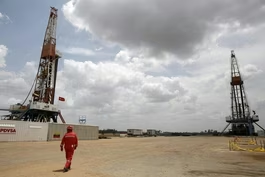
White House says U.S. will control Venezuelan oil industry
Video has Closed Captions
Clip: 1/7/2026 | 6m 9s | White House says U.S. will control Venezuelan oil industry 'indefinitely' (6m 9s)
Providing Support for PBS.org
Learn Moreabout PBS online sponsorship
- News and Public Affairs

FRONTLINE is investigative journalism that questions, explains and changes our world.

- News and Public Affairs

Amanpour and Company features conversations with leaders and decision makers.












Support for PBS provided by:
Major corporate funding for the PBS News Hour is provided by BDO, BNSF, Consumer Cellular, American Cruise Lines, and Raymond James. Funding for the PBS NewsHour Weekend is provided by...