
The M Factor 2: Before the Pause
3/19/2026 | 54m 45sVideo has Closed Captions
Before the Pause explores solutions for women experiencing perimenopause.
Before the Pause shines a light on perimenopause through real women’s stories—teachers, firefighters, and doctors—showing how silence and stigma derail lives, and why early awareness is essential to protect women’s health, work, and identity
Problems playing video? | Closed Captioning Feedback
Problems playing video? | Closed Captioning Feedback
The M Factor 2: Before the Pause
3/19/2026 | 54m 45sVideo has Closed Captions
Before the Pause shines a light on perimenopause through real women’s stories—teachers, firefighters, and doctors—showing how silence and stigma derail lives, and why early awareness is essential to protect women’s health, work, and identity
Problems playing video? | Closed Captioning Feedback
How to Watch The M Factor 2: Before the Pause
The M Factor 2: Before the Pause is available to stream on pbs.org and the free PBS App, available on iPhone, Apple TV, Android TV, Android smartphones, Amazon Fire TV, Amazon Fire Tablet, Roku, Samsung Smart TV, and Vizio.
Providing Support for PBS.org
Learn Moreabout PBS online sponsorshipAt one point, what I think was the worst point, my memory was so bad that somebody asked me what my name was, like, at a front desk, and I could not remember my own name.
Every woman's perimenopause is different.
We are born with a timeline.
We cannot control when our perimenopause and menopause will happen.
There's this need for knowledge.
There's this need and desire to take care of ourselves as women that I think my mom's generation certainly did not experience.
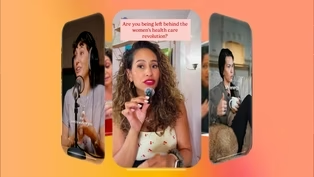
We are currently bearing witness to a woman's healthcare revolution.
You know, 80 to 90% of people get their medical information on social media.
If we didn't have social media, we would not have the awareness.
I've been dealing with the craziest, restless nights.
Where's actually all the women's health data?
Heart disease is the number one killer of women.
Eighty percent of heart disease is preventable.
The brain is in transition just as much as the ovaries are.
[Dr.
Rubin] Not feeling like myself.
We see mental health changes.
It impacts your mood.
It impacts your emotions.
It's amazing and so exciting that so many women are taking their health into their own hands.
That's why I talk about it.
So that nobody else has to suffer and not know what's happening.
This is a cultural movement.
This time in perimenopause is so crucial to understand long-term health.
My hope is that women don't fear.
[Dr.
Joffe] They will navigate this and they will get to the other side of it.
We call it like, the zone of chaos because estrogen and progesterone levels are up and down.
They're all over the map.
I was so excited when I went into menopause.
I could've thrown a party because perimenopause ended for me.
I don't want to develop chronic medical conditions that I can get ahead of now.
You need to be able to make decisions today for the life you want in the future.
Your 80-year-old self will really thank you.
[Dr.
Sylvester] So, welcome everyone.
Thank you so much for being here.
This is a topic near and dear to my heart, because there's something here for all of us.
I called it "The Talk," because so often my patients are saying like, nobody told me about this.
Like, how did I not know about this?
So, whether it's like happening to you right now, whether it happened to you already, and you have people in your life that it's gonna happen to, I feel like we need to bring back the talk for the perimenopause.
Everybody wants to know like, well, what am I in?
[orchestral music] So, perimenopause is the transition time leading up to menopause... Which means, your body is transitioning.
from the reproductive phase to a non-reproductive phase.
The averages is somewhere between 45 and 50, but some people go through it in their 30s.
and their early 40s, or even as late as their mid-50s.
I was under the assumption through, you know, the one hour of lecture I got in medical school and the six hours total I got in my residency that the premenopausal transition was this kind of gentle decline of ovarian function until full stop.
But what we've learned is that the ovaries go out fighting.
The symptoms of perimenopause, because estrogen is on every single tissue in your body range widely.
So yes, you could have hot flashes and night sweats, but really more commonly we see things like new onset of anxiety... -Brain fog... -Trouble sleeping... Cognitive fatigue or mental fatigue... Period changes, uh, that can go in any direction... Some skin and hair changes... Vaginal dryness... Wear and tear on your cardiovascular system... -Depression... -Weight gain... -Night sweats... -Cognitive changes, in terms of attention.
Just feeling like your brain won't turn on.
And it's not just the physical fatigue, but also emotionally, mentally, and sometimes, even spiritually.
A lot of women don't realize what's happening to them because they've never been informed on what perimenopause actually is.
[Dr.
Casperson] Nice to see you.
[Rachel] Thanks.
Good to see you.
So, remind me, like, when did you actually feel like perimenopause started for you?
I delivered my son and turned 35 right afterwards, and I think that my hormones just never went back to normal.
So, I started having symptoms, like, at 37.
Okay.
What did you notice first?
Achy muscles and joints, and then I had, was getting brain fog and a lot of fatigue.
Did you just think, I am tired 'cause I have a baby?
That's exactly what I thought.
I had actually started seeing specialists by this point because the muscle and, um, bone aches had gotten so bad and so did the brain fog, um, that they were screening me for MS.
Multiple sclerosis.
It was so stressful.
Yeah.
So, no one told me anything like this could be perimenopause.
And so, I was talking to one of my girlfriends, and she's like, I think you're in perimenopause.
Like, what are you talking about?
I have had all the normal labs done, and everything is good.
But things have just not been feeling like, right.
After I kept going to the doctors, after I had a biopsy, it was perimenopause.
To diagnose perimenopause, you need an educated clinician who understands all of the organ systems that might be affected.
You look at her age, her constellation of symptoms, and there you go.
What the ovaries are doing is they're kind of giving their last job, right?
They're like, we're here.
We want to play sometimes.
We want work hard sometimes and sometimes, we need a day off.
Sometimes, you get a lot of estrogen, then you'll get no estrogen.
You'll get an ovulation with an egg release, then you won't for a couple of months.
That can be very bothersome for people 'cause how do you treat a roller coaster or a moving target?
We are born with a timeline of fertility we are born with an expiration date in our ovaries.
We cannot control by our lifestyle or our eating habits or physical activity when our perimenopause and menopause will happen.
What we can do is to minimize the effects of some of the symptoms.
I like to think of perimenopause as a real opportunity.
If you are listening to your body and starting to do things to take care of yourself, that your 80-year-old self will really thank you.
But look at you.
Yeah, thank you for coming.
[overlapping chatter] So, like, as you get older, less risk of cervix cancer, something to look forward to.
-So, you win a prize.
-You win a-- I think women don't like talking about perimenopause and menopause.
It's the aging component.
And then the other thing is because of the constellation of symptoms that have so much overlap with other conditions, you sort of spend a lot of time not knowing, like, is it just me?
Is this part of this transition?
I'm starting to have young patients in their early thirties, mid-thirties, coming because they wanna learn and they wanna be proactive.
If we didn't have social media, we would not have the awareness.
We can't do anything if people don't talk about it.
I haven't been shy about my perimenopause journey.
I've been in perimenopause for three years.
And last year, at 45, I was at my worst.
When I was in perimenopause, I developed anxiety for the first time in my life.
And I actually think there's a beautiful concept and it is four simple letters.
"NFLM."
"Not Feeling Like Myself."
"I don't feel like myself" actually has been studied, that exact phrase, and it is likely the most common presenting factor in menopause.
I think we might be able to blame a lot of things on perimenopause.
So, you’re going around, you have your kids, maybe you're at work.
You're feeling like, okay, I finally am used to what's happening here.
And then, your sleep starts to change.
Your energy starts to change.
Man, anxiety might start to just... "Why am I so anxious about that?"
You get million dollar workups in your forties, because you go to many, many doctors, and they say the same things to you.
We ruled out all the bad stuff.
This is just what happens as you get older.
I started getting the anxiety after my son was born.
-Yeah.
-And it was, you know, a lot.
You know, I am a therapist, and so I know what anxiety is, and I can just remember, I could just be sitting on the couch, and all of a sudden I'd have this wave of anxiety come over.
but I didn't know where it was coming from.
Mm-hmm.
What we know now is that the first symptoms that tend to happen are neurological.
For most women, this is just now clear that the brain is in transition just as much as the ovaries.
For some women, they come to us saying that they're terrified that they may be experiencing early onset dementia.
That's a very, very common complaint.
Other women will come to us and say, I feel like I have ADHD, and for other women it could be depression.
For other women, it could be panic attacks.
[Dr.
Joffe] When we say mood disorders, you know, we're talking about brain and depression and how our sense of self and how we're interacting with the world and perceiving the world.
Some people do, you know, really fear that as they go through this stage of life, they will have, you know, significant effects on their well-being and the way that they have joy and interact and have pleasure and feel positive.
Do you remember last summer when I was crazy?
[laughs] -No.
-[laughs] That was, I think, when I realized that this was the beginning of menopause.
And I didn't even want to tell you, because I didn't... [voice breaking] it's embarrassing.
I don't even know anything about it.
So, for me, it's, you know... -Yeah.
-You know.
I wouldn't know what to be embarrassed about.
Yeah.
And embarrassing might not be the right word... I was just so lost.
You can always be honest with me.
If you're having those hard days, I can make 'em easier.
Or, if you need me away from you, -I'll get away from you.
-[laughs] And if you want me close, I'll be close to you.
I don't, you know, 'cause I-I... I guess sometimes, I just can't read you, and trying to guess what you're feeling could definitely make for a worse day.
Having that support is huge for me.
Just to know that... I don't have to hide it.
I don't have to try and pretend through it.
I'm not gonna be, as I said, leading any groups.
[laughs] But I'm not going anywhere, either.
[Andrea] Good.
I'll still stick with your crazy.
Good, 'cause you're stuck with me.
-I know.
-[laughs] [kisses] Somebody might recommend hormones, somebody might recommend more traditional, uh, brain-based treatments, we call psychiatric medications, or antidepressants, psychotropics.
And there can both be good options, and they're important to consider.
They can be used separately, they can be used together, but we know that the hormones are gonna be effective for the hot flashes.
And then there's a secondary, uh, benefit for the mild mood condition.
I was 42 when I started to have perimenopause symptoms.
I just felt distracted, and I felt frustrated and I couldn't concentrate.
And that was really scary to me.
At one point, what I think is the worst point, my memory was so bad, that somebody asked me what my name was, like at a front desk, and I could not remember my own name.
My mom found a doctor that she really liked, and I finally got in with her, and she listened to me.
She didn't negate my symptoms.
I felt like the other doctors had just been like, well, yeah, this is what happens now.
You're gonna live like this forever.
And what she recommended for me personally, and again, I want to just say that I think every person needs something very different.
So, just what I'm doing isn't what everybody should do.
The teacher in me needs to say that.
Um, so, I'm now on a estrogen patch, estradiol patch, that I change twice a week.
I'm taking progesterone, 200 milligrams at night.
It has helped so much.
There's a big reluctance among some women and some doctors, I think because of what happened with the Women's Health Initiative study.
So, things were going well until about 2002.
And that's when the Women's Health Initiative trial was published, and everything changed.
The original press conference in 2002 introduced the results of the Women's Health Initiative.
It increases the risk for, uh, breast cancer, and for blood clots.
That was the next day's headline in The New York Times.
And that's been the headline event since then.
We were very aggressive in sort of pulling back hormones from everyone, stopping women mid-therapy.
But the trouble is, the data was flawed.
[Dr.
Casperson] So, like, why didn't doctors speak up?
They couldn't speak up.
There was no social media in 2002.
We've learned that it was an error on our part, a misinterpretation of the data.
And that has set us back by 20 years.
Because we thought that HRT wasn't something we were going to be able to use.
Menopause didn't make it into training.
I went through residency during this time when the WHI study came out, and I remember receiving one lecture on menopause.
And so, when I came out in the workforce, starting to practice, I did not feel equipped to really help women.
And I did not want to ask questions around this.
I did not prescribe hormone therapy at that time.
I did not know how to do it.
And so, we have to do a lot of work to, to rebuild.
It's essential that women know that there is something out there that's really gonna help with longevity, with healthy aging.
You know, it's... What's not good about HRT?
Today, the FDA has decided to remove the black box warning on hormonal replacement therapy.
This isn't just vaginal estrogen, y'all.
This includes systemic hormone therapy.
I believe this is about time.
The FDA is taking action to remove the black box warnings from estrogen related products.
This is based on a robust review of the latest scientific evidence.
We don't believe in medical dogma, we believe in evidence, science, patient choices, and restoring the doctor-patient relationship.
Ultimately, it's about us empowering a patient to have all the education about the risks and the benefits, and for them to gauge their risk tolerances and decide what's really the best way to proceed for them.
There are many, many reasons why we might be using hormone therapy, but the biggest reason is for symptom management.
There's such a range of symptoms that can potentially be coming up, and one thing I like to say is that when you hear a list of symptoms, to know that it doesn't mean it's all doom and gloom, and it doesn't mean you're going to experience all of these things, but it's helpful to hear what the different symptoms are, so that if you are experiencing them, you can start to connect the dots and recognize that they might have to do with perimenopause.
[traffic noise] [Raymond S. Johnson] Gentlemen, it is good to see you.
As you know, this is our regular meeting of Let's Talk, Let's Listen: A Husband's Conversation.
At one point last year, we talked about a topic that I realized is not being talked about a lot.
and it's not being talked about a lot amongst women.
So, if it's not being talked about a lot amongst women, it's probably never talked about amongst men, right?
Which topic?
And that's the subject of perimenopause and menopause.
[Brian Gaffney] I guess I'm coming to you from Camp Menopause.
-[laughs] -[Brian] Officially.
Um, and what's interesting, and what was interesting for us was we have two boys, 15 and 17 now.
And so, some of the exhaustion, some of the irritability, some of the not being in the mood when it comes to intimacy, you know, wasn't necessarily tied or associated initially with menopause, but it was like, I'm exhausted, it's the kids, it's you.
I'm just tired, right?
And then, she noticed it in her conversations with her doctor, and then that allowed it to come into the conversation between the two of us, and figure out, okay, there's this new dynamic in the relationship.
We need to start talking about this to figure it out.
When I finally found out what it was, I was like, yes!
[laughs] It wasn't me.
[all laugh] Right?
So, I got really lucky in not having to guess what was going on.
The kind of opposite happened with me in that the issues that we were having in our relationship... came up as something was wrong with me.
[man] Mm.
Which was the reason we were having problems.
I'm not doing enough of this.
I'm not being as attentive.
I'm not as romantic.
It kept being, "It's you, it's you, it's you."
It wasn't until some time had passed that we began to realize, no, it's something that's happening with you, with this perimenopause, that's causing you to kind of see me in this light.
I'm not the problem.
She's not the problem.
The problem was was, uh, the perimenopause and the menopause.
[Dr.
Rubin] What do we mean when we mean sexual health?
It's really important 'cause sexual health is just health.
[Dr.
Day] One of the most common symptoms that people are surprised to hear that it could be related to perimenopause is a change in libido.
And it's something that a lot of people have a lot of grief around of, "Oh, my gosh, is my sex life over?"
And I think that is just absolutely incorrect messaging.
It's really an opportunity for us in many ways.
-I've a brand new relationship -Mm-hmm.
with somebody I've been with for a long time.
But all of a sudden, what do you like?
Because now, what you like intimately is different.
-Mm-hmm.
-Right?
Things I may have done in the past that worked, may not be as effective anymore.
So, you know, this old dog's gotta learn some new tricks.
Right?
But all of those things, what intimacy is, what foreplay looks like, what romance looks like.
And I think when you're working towards that, it also, um, helps foster more love.
Right.
And to just show some understanding.
Right.
Just so it makes the atmosphere a little lighter and whatnot.
So, we look at it kinda like a teamwork effect.
You know, I wonder sometimes, like, what our fathers would say about us sitting here.
-[chuckles] You know, like... -[men laugh] "They're sitting on couches talking about your wives."
Like, you know?
Y'all are different, right?
Like, so, like to make the steps towards progress and you know, just... believe in us, and we'll get there at some point.
People think sex is extra.
And I talk about like each hormone has its own stereotype.
Like testosterone has a stereotype for libido, but it helps for other things.
But estrogen also can help libido.
-I have a question.
-[Dr.
Sylvester] Yes.
My doctor, she wanted to talk to me about testosterone.
-Mm-hmm.
-[woman] I'm reluctant, because I was like, I don't want to grow chin hairs.
I don't want any of that.
Testosterone is sort of like the outlier.
There is no FDA approved testosterone for women.
So, when we give it, we are making up the dose, like literally.
And we just know men make ten times more than women.
So, let's give you one tenth what men get and check on your chin hairs later.
-[all laugh] -[Dr.
Sylvester] We do.
But it's one of the sex hormones that plummets at the menopause, right?
So, there is a role for testosterone in women.
There is.
What we do know about testosterone is it probably has a good role in body composition.
So, like keeping some of that muscle mass probably has a role in energy and cognition and things like that.
The way I like to look at it is with your hormone therapy, you're making like this delicious soup, right?
You have all the ingredients, the testosterone is that little bit of salt.
It's gonna enhance everything.
So, I really like to get people well established on their hormone therapy, then, if we're looking for that little extra edge, that little extra push, then that's where we add testosterone.
It's very nuanced.
Many, many of my patients, after they're well established, are like, "Remember, you promised me the testosterone?"
And so, we revisit it.
So I do give it, I do give it.
Have I started it?
No, but I do give it.
It'll come.
I'll let you know.
Yeah.
[laughs] The way I describe perimenopause management is I think no option is good or bad, right or wrong.
The first option is suck it up, do nothing, and just power through.
That's what most people are doing.
Option number two is birth control pills, because what happens in perimenopause is it's this chaos.
Your highs are high, your lows are low.
It's the fluctuation of hormones that create so many symptoms.
And birth control shuts down your ovaries so there's no fluctuation, and it adds back synthetic sort of fake estrogen and a synthetic fake progestin.
The reason I don't love it is because those forms of hormones can sometimes come with side effects.
Some of our patients have mood changes or weight changes.
Birth control dosing is more potent in the sense that it's going to stop ovulation to prevent pregnancy, versus menopause hormone therapy is, number one, a different type of estrogen and progesterone, but also it's not enough to stop ovulation.
Your ovary will still do its dance.
Hormone therapy can absolutely be given in perimenopause, because it isn't harming the ovary.
It's not aging the ovary or doing anything to the ovary.
The ovary is going to do what it normally does.
One of the big misnomers is that menopausal hormone therapy is high doses of hormones.
A normal ovulation cycle, women's estrogen goes from around about 30 up until the hundreds, 400, 500, even higher, up and down every month.
The amount of estrogen in a menopausal hormone therapy dose is roughly around raising a level to about 30 to 50 or 60.
Right?
So, it's a much smaller amount than your ovaries are actually making during your ovulatory cycles.
[Dr.
Sylvester] Yes.
What if you can't do hormone replacement therapy?
I had an estrogen positive breast cancer a couple years ago, and I'm on Tamoxifen -[Dr.
Sylvester] Yes.
-I'm real hot and sweaty.
[Dr.
Sylvester] Yes.
And so there are, so when it comes to like symptom management, like depending on what the symptoms are, there are definitely ways to do it without hormones.
Most women are good candidates for hormone therapy.
There's a very few that are not.
And yes, that is one of them, unfortunately.
I'm a medical oncologist.
I take breast cancer very seriously.
My wife had breast cancer.
My daughter had breast cancer.
My sister-in-law had breast cancer.
Sixty percent of my practice was made up of women with breast cancer.
I know that this is a serious disease, but based on everything I can see, hormones would be of much greater benefit for women than a risk, and that's not the way it's perceived.
Estrogen is the single best treatment for perimenopausal and menopausal symptoms.
It's really important to recognize that the fear of getting breast cancer is driving all patients and doctors’ decision making when it comes to deciding on hormone therapy and menopause, right.
If a woman is treated for breast cancer is hormone therapy ever an option for her?
The blanket answer is yes.
My experience and how I practice medicine is really impacted by my own personal medical story.
And when I was a second year OB-GYN, newly married, only 28 years old, I felt a lump.
And I thought I was too young for breast cancer.
Two months later, in November of 2001, my mom, at age 54 suddenly died of ovarian cancer.
And a few weeks later, I found out that I had Stage 2A ER-positive breast cancer.
I experienced the ravages of abrupt surgical menopause.
When I had my ovaries removed, that surgical menopause, it hit me like a freight train.
It wasn't until years later when I became a certified menopause practitioner and really did continual medical education that I learned how we have to take care of the sexual health and you know, menopausal side effects.
[Dr.
Sylvester] I don't know if anyone's experienced it, but the doctor will say, no.
You've had breast cancer, no.
Can't help you.
Good luck to you.
Here's a fan, you know.
[all laugh] [Dr.
Sylvester] But no, that's not okay.
There is so much more that we can do.
[Dr.
Menn] We do have non-hormonal options for women who choose or we decide absolutely, it's not the best idea for them to have systemic hormone therapy.
We really lean into lifestyle, nutrition, exercise.
They can always have vaginal estrogen.
It is safe, local, not systemically absorbed.
Let me be clear, vaginal estrogen is safe for all women.
Yes, including breast cancer survivors.
As a breast cancer survivor myself, I use vaginal estrogen.
I prescribe vaginal estrogen to breast cancer patients.
including those in active treatment like chemotherapy, or taking estrogen blockers, tamoxifen, et cetera.
We're finally moving into a place where women are demanding nuanced individual decision making and shared decision making when it comes to that.
Um, it's not a "hell, yes."
It's not always a "hell, no" though.
And women deserve to be able to make this decision with information and not just being told no, we're not talking about it.
[Dr.
Morgan] What I want women to know about heart disease Is that heart disease is the number one killer of women.
It is not breast cancer.
And kudos to breast foundation for making certain that they raise awareness and visibility.
And people now think it is actually the number one cause of death and the biggest threat to women, but it's actually heart disease.
And guess what?
It's always been heart disease.
One of the amazing things about being a cardiologist is that 90% of heart disease is preventable.
So, even if you have the world's worst family history, you can still prevent heart disease.
That is news we should all celebrate.
But we can only prevent risk factors if we know our risk.
If we don't know our risk, we can't prevent it.
And so, really critical to that is understanding what your risk factors are.
So, blood pressure, cholesterol, you know, glucose, which is diabetes, not smoking, knowing your family history.
Your first indication of a heart attack is not the actual heart attack.
It's a number of things that lead up to that heart attack.
These symptoms of perimenopause are actually markers.
They're little signals to let you know that your risk of heart disease is increasing, because your estrogen levels are dropping or becoming more irregular.
We recommend all women when they reach the age of 20 or 25 to get a baseline cholesterol testing, get a, you know, blood pressure check, get a glucose check.
Those are really critically important not to start on medications, this is not about medication.
This is about understanding your risk factors.
One of the things I find so interesting is pregnancy is a very potent indicator of what's gonna happen to you cardiovascular-wise later on in your life.
So, for our women who've had high blood pressure during pregnancy, gestational diabetes, or they've had adverse pregnancy outcomes, either early delivery or there are host of other things, it greatly increases their risk for having heart disease.
It's really important to lower blood pressure, because blood pressure is a silent killer.
It doesn't hurt until you have a stroke.
It doesn't hurt until you have a heart attack.
You know, we often think about medicine as some type of a moral failure.
It is not.
It really is not.
After you've done everything right, after you've done the diet and exercise, and if it doesn't work, aren't we so lucky to live in an era where we actually have something that lowers our blood pressure, lowers our cholesterol.
Heart disease increases in perimenopause, because as we begin to transition towards menopause, we begin to lose estrogen.
And estrogen protects the heart.
You know, trying to make certain that we have enough estrogen within our bodies is really a new concept.
And why is that?
It's really been in the last 100 years, which is a relative short amount of time, that people really have been living beyond our reproductive years.
[Dr.
Cho] Like everything, it's nuanced.
For women who've never had heart disease, turns out that maybe if you started the hormones in their fifties, you know, right after menopause, that it might not be as harmful.
So, that timing hypothesis, so that if you start early, that maybe it actually is helpful.
This is really where shared decision making becomes so critically important.
So, we have to use the information that we have.
and we know that transdermal estradiol, we have studies on this, decreases your risk of diabetes, decreases your risk of depression, helps you sleep better, can lower your cholesterol.
It lowers blood pressure in some people.
And those are all risk factors for heart disease, right?
We have to use the data that we have.
Why aren't we using the data that we have?
Even if we do not ever get that randomized placebo controlled trial showing it prevents heart disease, it's not making your heart disease worse, right?
And it'll help all these parameters that decrease your risk of heart disease.
What's important is, is that you are taking hormone replacement therapy in conjunction with your physician.
So hopefully, somebody's monitoring you.
And I don't want anybody to be scared 'cause you're taking it for menopausal symptoms.
You know, there's no "one size fits all."
And hormone replacement therapy is sort of the best example for that.
I'm incredibly optimistic about the future of cardiac diseases.
We have treatments, we are diagnosing people earlier, but I'm most excited about the focus on prevention.
Things that we used to do before wouldn't work anymore.
You could do the exact same workout that used to work for you, eat the same way.
It's not, it doesn't work anymore.
Yeah, so, where to start?
Of all the things I like to say, there's like a thousand things that one could do to help their health.
So, what should you focus on?
So, the first thing we do is talk about her nutrition.
Food is the number one thing we can do to affect change in our health.
People feel like water is not really a nutrient, but I think it's really important to change that and re-frame water as a natural nutrient for the brain.
So, the brain is the organ with the highest concentration of fluid per density.
Even mild dehydration has been shown to have a negative impact on brain health.
Tap water is perfectly fine.
Mineral water is even better.
Every single one of my patients is like, I don't wanna develop diabetes.
I don't wanna develop chronic medical conditions that I can get ahead of now.
[Dr.
Haver] When estrogen levels decline, we see rising inflammation levels, but specifically to hormone changes, we see rising insulin resistance.
The consumption of lean protein can regulate glucose, can prevent insulin resistant Hyperinsulinemia.
I'd like to say that we could get everything we need from food.
That would be ideal.
But as we go through life, we just require more.
I believe that many perimenopausal women have what's called the Shiny Object Syndrome.
SOS.
They are looking for help.
So, they go into a grocery store and they see all of these products, but without really knowing what all of those products do.
When I think of the foundations, especially for a woman who doesn't have a lot of money, I think of the big five.
I think of magnesium, I think of vitamin D. I think of a quality B vitamin.
Sometimes, I think about iron, and it just really depends on the stage of perimenopause that a woman is in.
And then finally, Omega-3 fatty acids, so important for every cell's function.
And it's been estimated very recently that 85% of people are deficient in Omega-3s.
So, Omega-3s are implicated in mood, in brain health, in inflammatory processes.
So, we wanna get those things right.
Here's the thing, we don't know a lot about supplements as providers.
We were never taught about supplements in medical school.
We have a lot of learning to do.
Some people say, oh, there's no research on supplements.
There actually is.
If we look on, you know, PubMed is the main research portal.
and you look up the ingredient of almost any vitamin, mineral, nutrient, herb, uh, amino acid.
Like there are so many research studies done on these ingredients, and many of them have been shown to have efficacy.
Uh, many of them have shown to have safety.
You want to make sure that what you're spending your money, your time, your energy to take these things, that it's actually what your body needs.
When you hit your 40s and stuff starts doing this right here, do it ever do this?
We're in menopause.
We go from happy to sad, to angry, back to happy, then sad again, in less than a minute.
[birdsong] Okay, well, Beyla, do you think, I don't know, who do you think is more moody, you or me?
You.
Why?
'Cause I would've said you.
Um, I'm always afraid to like ask a question at the wrong time, because your mood just fluctuates.
Yeah, like I'm perimenopausal, and so, you know, sometimes, I don't have the patience and, or the energy to sort of think before I speak.
I always know like, oh, she is perimenopausal, so I always try to be like, empathetic, but it's hard.
Yeah.
You know, I'm a menopause doctor, so I kind of know why this is happening.
But it's also interesting when it's happening to you, myself.
You know?
There's always side conversations with me and my dad, like, she's in a bad mood, -like, be careful.
[laughs] -[laughs] Or my brother, I'm like, she just got mad at me.
Like, take five minutes and then go talk to her.
We just know that if you get angry at one person, it'll happen to all three of us.
It's kind of like a chain reaction.
[Dr.
Patil] I mean, I love you.
We're still gonna be family no matter what.
[laughs] [Dr.
Brenton] More women get diagnosed with Alzheimer's than men.
For years, scientists assumed that was because women tend to live longer.
It's not because women live longer than men by 4.5 years.
It's because the disease can start earlier in women during the menopausal transition.
Menopause is an active process that does change your brain in ways that we're just starting to quantify and to actually be able to see.
I launched this program of research care with Wellcome Leap to really focus on women's brain health, menopause, and the risk of Alzheimer's for women.
And we are going to look at biomarking clinical data from over 20 million women.
This program of research is effectively the largest global initiative in women's brain health, menopause, and Alzheimer's disease ever attempted.
So, Alzheimer's has been considered as a disease of old age.
But a lot of my work and other people's work has shown, has proven that Alzheimer's is actually a disease of midlife with symptoms that start in old age.
And for women, this timeline appears to coincide with the transition to menopause.
On this slide, what you can see is that we have three women.
A woman who is premenopausal, one who's perimenopausal and one who's post-menopausal.
And what is important here is that they're all the same age.
These brain regions that show a decline in energy level are the same brain regions that are metabolically impacted by Alzheimer's disease, And these changes seem to start during the perimenopausal stage.
We have three years to answer a high risk, high reward question.
And their overarching goal is to halve the lifetime risk of Alzheimer's for women from 20% to 10%, so effectively, to equalize risk across genders.
The way we do this is by working with women beginning in midlife, when the potential for prevention is greatest.
The program of research aims to reduce risk of Alzheimer's for an estimated 330 million women, and prevent 55 million future Alzheimer's patients among women by the year 2050.
People are terrified of that loss of brain function, dementia and Alzheimer's.
And so, that's where I can bring a lot of women to the table.
And when I say like, look, the earlier we start, we know the earlier we can impact brain health, that's when their eyes and ears perk up.
[Dr.
Mosconi] There are studies that have been done looking at nutritional supplements and brain health, where brain health is specifically mainly cognitive function, Alzheimer's disease, cognitive impairment, depression, anxiety.
Uh, these are chiefly Omega-3 fatty acids, And then, the B vitamins are typically good for brain health, especially B12.
In fact, when we do a diagnosis of dementia, we always test vitamin B12 levels, because of deficiency in B12, even a subclinical deficiency, can mimic the brain fog some people report in early dementia.
I, frankly, am tired of putting metal in the hips of women, when we could've prevented the problem in the first place.
So, my urgency for women is we have got to lay down enough bone.
When estrogen walks out the door, we're dissolving more bone than we're building.
I think every woman should understand her bone health, at least by the time she's 40.
Just like we get mammograms.
Whether that means we have to pay for a DEXA scan or a REMS ultrasound, maybe that's what we have to do.
I think the most important decision a woman can make in regards to her bone is the decision on whether she is going to supplement her estrogen, progesterone, and testosterone.
[Dr.
Singer] Hormone therapy can certainly be used in the setting of osteoporosis prevention.
We do actually have fracture data from the Women's Health Initiative.
That shows that hormone therapy, either estrogen alone, or the combination of estrogen and a progestin, decrease fracture risk at important sites.
The best ways to build bone is number one, impact exercise.
Our body takes the biomechanical energy of impact and turns it into signals for laying down bones.
Number two, we need to lift weights.
Muscle pulls on bones and helps build them.
Number three, we have to eat enough.
Our body is gonna sacrifice our bones so that your heart can work, so that your brain can work because of the minerals that our bones house.
I think the reality is that people have to understand the consequences of doing nothing and not really addressing issues when they exist.
Nothing we do is going to prevent fractures by 100%, but the more we can reduce them, the less we have to be reactive down the road.
[Capt.
Bailey] So today, we're at Fire Station 27.
I've been employed with them for 22 years.
It's been a fantastic career.
I still love coming to work every day.
As I started to go through perimenopause, it was right about the time I was studying heavily to be a captain on this job.
Along with being a mother to a young son.
A lot of the things that I was experiencing, I really thought were stress related.
Started seeking some help from doctors because I felt like I just wasn't myself.
For approximately two years, I was trying to get answers of why I felt so terrible.
I started getting the same kind of answers of, specifically, this is something that you're gonna have to deal with.
This is perimenopause.
It's normal to feel terrible, get used to it.
After two years of kind of getting nowhere, I ran into a friend that kind of pointed me in the direction of a doctor that did bioidentical hormones.
Within, I would say, three weeks, I felt a drastic difference.
I felt like a different person.
One of the things that was very unique with my situation, obviously, going through this, was making sure that, every day I came to work, that I was functioning at a high level and had the capabilities of doing my job to the best of my abilities, and making sure that all of my members of my crew go home safely to their families the next day.
We want to live a long, healthy life, the longevity, the health, the mental and physical well-being is all encompassing in that.
[Dr.
Patil] It shouldn't take that we have to be specialized in menopause.
I love seeing, you know, our job is to see complicated patients, but every single person who takes care of this population should know and recognize what menopause is.
How does it present?
How to take care of menopause?
Perimenopause and menopause are not limited to OB-GYN, right?
So, anyone who sees a woman in their late 30s, in early 40s, needs to have the education around perimenopause and menopause.
[newscaster] Now, an innovative new program in Los Angeles is giving women the care they crave.
When I created the program, I specifically chose specialists in specific fields like cognition, bone health, sleep health, et cetera.
And I said, who is interested in working with me to come up with menopause flow algorithms for your field?
We use their own specialty expertise.
We used our menopause expertise to come up with these flow algorithms, and we coded them in such a way that we figured out who would be high risk, who would be low risk, who would be medium risk, to help triage our patients, so that we get a snapshot of what is happening to them before they even walk in the room.
You know, I know that you did get a chance, hopefully, to review her chart.
And, um, also, just understand how our tool works in terms of helping us prepare, to really see her and make our visit really fruitful.
I did.
It was really interesting to see all of the information.
The cognition was red.
So, I think that should be a bulk of today's visit and talk to her about the symptoms she's having.
Great.
Well, let me go ahead and get Priya.
-Okay?
-Great.
-Hi, Priya.
-[Priya] Hi.
How are you?
-So nice to see you again.
- Nice to see you, too.
-Come sit.
-Hi.
I'm really excited to hear, you know, how you're doing with the cognition, specifically.
Yeah.
That was one of the main reasons I came to see you is that I was forgetting so much.
You could tell me a phone number once and I would memorize it.
Now, I wouldn't even know my daughter's number.
But I was worried about early onset dementia, and so, when you sent me to get the cognitive testing done, it was a long day of testing, but actually, it made me feel so much better.
And then diet, exercise, social connectivity, um, you know, sleep, you know, focusing on that, avoiding excessive alcohol.
These things all really make a difference and they're just as important as this other factor that we don't have control over.
What do you feel like has been the most helpful other than exercise and sleep with your cognition?
Actually, just knowing that it's temporary and the ship will upright itself, ultimately, I think I didn't realize that.
Like, I thought it was just cognitive decline that was gonna continue to just go down instead of that this is a phase of our life and it's gonna go back up.
Absolutely.
And your brain is a beautiful thing.
It definitely will, you know, work to create those neural connections again.
It just takes time.
And um, you know, I'm not gonna say there are some people where there is that lasting issue that then leads down the road.
But for the majority of people, this isn't the mainstay.
Well, I'm so grateful to know that -and it just helped me so much.
-Good.
Well, it's so nice to see you.
And I will look forward to seeing you next year.
I'll see you in a year.
-[Dr.
Patil] Take care.
-Thank you.
So, quality of data is really key when you're building anything.
And I'm a scientist.
We spent years looking at disease prediction and prevention and then, just one day, it was quite an embarrassing moment when you go, where's actually all the women's health data?
[Dr.
Potter] In 1977, women in the US were prohibited from clinical trials.
They said it was dangerous because they're in childbearing years.
Researchers thought that women's hormonal fluctuations made them too difficult and too expensive to study.
We weren't allowed back until 1993.
Most of what we know about medications, most of what we know about medical devices have been, the research has been done on men and extrapolated to women.
So, fundamentally, a lot of the recommendations in women's health today, is still being made on poor data.
We have been left behind and how are we gonna catch up?
Well, now we have AI to help us with that.
This fear around AI is very real, and as someone who is also an AI ethicist, healthcare is the one bright, shiny spot I see on the near term horizon, especially for women's health.
[Dr.
Davis] But what's really powerful about AI now, what's really good at finding patterns, In large data sets that I couldn't do, or any scientist couldn't do alone, and a doctor couldn't do.
So, what it can help us with is to really start understanding what's going on with women and start personalizing that journey.
This time in perimenopause is so crucial to understand long-term health.
So, if we can start tracking continuously over time with a wearable.
Once you see the early signs of disease, you can start by either reduce the risk or delay disease onset, and that's really important.
But we have to be careful, because the bias that exists in the healthcare system today can get worse if we don't do this right.
[Dr.
Sly] A significant amount of bias exists in data and in models.
Most wearables have been standardized against white skin, which means that any form of biofeedback, the darker the skin, the less accurate it's going to be.
So, we don't have data that is verifiable across a variety of skin tones, as an example.
Does a woman have the ability, if she is going to use some kind of digital platform to have a choice of more than one race?
That's important for us and what we're building and creating.
So, we look at all of the data bias and can we reduce it?
The answer is yes.
How we do it, as an example, if I have biofeedback from my wearable and my wearable is showing a certain amount of stress, and I have the ability as a human to say, yes, this seems accurate, now I am validating my own data.
And that's how we are gonna create better data, more accurate data, and better models.
We get to build the tools that change it for the next generation, and I don't want my daughters to suffer like I did.
I think it's incredible when you see women come together and bring what they mean, what they think is really important to the forefront.
When women come together, they really make change happen.
[Dr.
Casperson] We know people get their medical information on social media, and anybody who's arguing that or wishes it would go away, like, it's not going away.
The social media impact of menopause, perimenopause, what I really like is it just sort of normalizes it.
It makes women feel comfortable about talking about it.
I think we're really moving very strongly away from the idea that there's some doctor who stands on a pedestal who has all the answers, and we just have to go and listen and do what we're told.
And we really are being, uh, proactive in our own health.
[Dr.
Singer] I think some of my colleagues would look at it as a double edged sword.
But anything that makes clinicians realize that they need to learn more so that they can help women through this journey, I think that's a pro and that's a benefit.
I see this as a grassroots rise up from the bottom up.
They're coming to their doctor's offices, they're saying like, hey, I learned this, I want to know this.
And so, it's pushing doctors to be more curious and to kind of meet that demand.
For a while, you might be more educated than your doctor is.
We have to do our job as physicians; it's really building that trust.
If it means like circling back two or three or four times, then I, then I will.
You know, when we look at mid- life, this doesn't have to be a time where we shrink ourselves, it's actually a time where we expand ourselves.
We have so much experience, so much lived experience, so much information, so much education.
We need to be stepping forward and not stepping back.
We know that the perimenopause is a fundamental like inflection point in health.
And this is the time to like get it right, to make sure that one's trajectory beyond it is as optimal as possible.
What my friends generally tell me all the time when we talk about, are we going to do it now?
We'll do it later, that's next.
Do not do your health later.
Remember there are seven days of the week and "someday" is not one of them.
If I'm not having a great day, I'll say, "Hey, guys, Ms.
Sotero is not having a great day.
She's a little moody.
She has to open up the window a lot today.
It is not you, it's me.
They've said to me that they like that they don't have to pretend in my class.
And so... I would not be as good of an educator if I wasn't going through this, I don't think.
I really don't think so.
I've had to give myself a lot of grace in this process and in it, I see the kids struggling hormonally, and now I give them more grace instead of being frustrated with them.
I'm like, we're in it together.
We got it.
Video has Closed Captions
Before the Pause explores solutions for women experiencing perimenopause. (20s)
Providing Support for PBS.org
Learn Moreabout PBS online sponsorship
- Science and Nature

Explore scientific discoveries on television's most acclaimed science documentary series.

- Science and Nature

Capturing the splendor of the natural world, from the African plains to the Antarctic ice.












Support for PBS provided by: